
Babies are born with a built-in natural sucking reflex which helps them eat, calm down, and feel secure. So if you are or have been a toddler parent, you might have stood in a doorway watching your tiny bundle of joy go absolutely feral with a dummy in their mouth. Thumb sucking and dummy use are very common during infancy and the early toddler years. A thumb is soft, small, and completely harmless, which makes it genuinely hard to believe that sucking on one for a few years can physically reshape the bones in a child’s face. For most kids, these habits slowly go away by themselves as they get older. If your young child still uses a dummy to fall asleep or sucks their thumb sometimes while watching TV, there is usually no need to worry. But it’s worrisome if the habit persists for a long time.
A child’s mouth keeps growing as they become older, and baby teeth are making space for adult teeth; the jawbones are growing, and the mouth muscles are learning to work properly. During this growth time, repeated gentle pressure from sucking can slowly affect how the teeth come in and how the bite develops.
In this guide, we will explain how thumb sucking and dummy use affect tooth position, jaw growth, and bite development.
So let’s sink those baby teeth into it……..
What Thumb Sucking Does Inside the Mouth
Every time a child sucks their thumb or dummy, different parts of the mouth are involved in this activity at the same time. The thumb or dummy presses against the front teeth, the tongue moves, the lips close around it, and the cheeks push gently inward. A few minutes of sucking will not cause any lasting change, as the body is very good at dealing with occasional pressure. The situation changes when the same high level of pressure is being applied every day and for long periods. Unlike a sudden hit that chips or cracks the tooth, thumb sucking creates gradual changes over time. It’s like wearing the same shoes every day; you will not see the changes straight away, but over time the wear and tear will be more visible. Gentle and continuous pressure slowly encourages teeth to move, and that’s the same natural process that orthodontists use with braces and clear aligners. Braces do not shift teeth in a single day, but they apply gentle, steady pressure over time so the bone around the tooth can change and the tooth can move slowly into a new place called bone remodeling.
Children’s jawbones are constantly growing. The upper jaw, lower jaw, face muscles, and the shape of the dental arches are all developing at the same time. IF a thumb or dummy stays in the same position very often, the growing parts of the mouth can adapt around that habit.
Did You Know?
Orthodontic studies have shown that the duration of a thumb sucking habit is often more influential than the amount of force. In simple terms, gentle pressure applied for several hours each day usually has a greater effect than stronger pressure applied only occasionally.
How Thumb Sucking & Dummy Can Alter Tooth Position
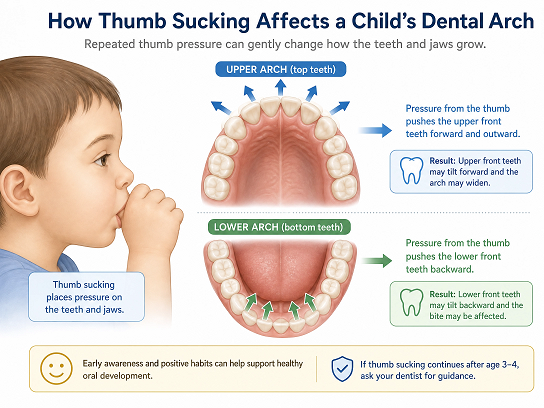
As a child’s mouth grows, the teeth naturally adjust to the space they have and the pressure they feel. When these habits continue past early years, certain changes in tooth position can start to show.
Upper Front Teeth May Start Moving Forward
The upper front teeth may begin tilting or moving forward. One of the earlier signs dentists see is the upper front teeth starting to lean outward. The thumb or dummy rests behind the upper front teeth and applies gentle pressure. Because this pressure happens again and again over many months or years, the teeth can gradually tilt forward. Parents may notice that their upper front teeth seem to stick out more than they used to.
Lower Front Teeth Can Lean Backwards
While the upper front teeth are being pushed outwards, the lower front teeth usually get pressure from the opposite side. Instead of moving forwards/outwards, they may begin tilting slightly inwards. This combination increases the distance between the upper and lower front teeth, making the bite less balanced.
Small Gaps Can Start Appearing
Small spaces can form between the teeth. Some children start getting gaps between their upper front teeth. This is not because the teeth are going apart by themselves. The repeated pressure slowly pushes the teeth into new positions over months or years. These gaps sometimes close on their own when the habit stops, but others may stay depending on how old the child is and how far the teeth have moved. Instead of tilting outward, the lower front teeth may start tilting slightly inward. This combination of changes increases the gap between the upper and lower front teeth, making the bite less even. The way the teeth meet can become less stable.
The Bite Can Become Less Stable
Teeth are meant to meet in a balanced way when the mouth is closed. If several front teeth slowly start to move, this balanced meeting can start to change. Some teeth may meet before the others when the mouth closes, and some teeth may stop meeting. Other teeth altogether may end up carrying more chewing force than they are meant to handle. These changes usually happen so slowly that parents often do not notice until a dentist mentions them during a regular checkup.
Common Bite Changes Dentists Look For
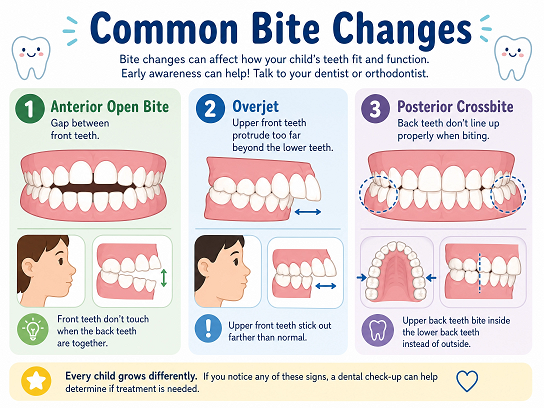
The dentist is looking for some common bite changes that he might observe. Disorders due to thumb sucking or dummy use are not common in all children. When the habit persists over a lengthy time frame, however, there are a number of patterns a dentist may check regularly.
Anterior Open Bite
Anterior open bite has only to do with the front teeth not touching when the back teeth are touching. Close your eyes and pretend your toddler is biting as he always did.
The molars meet.
The jaw closes.
However, there is a mini-gap between the upper and lower front teeth. That space is an open bite where the front teeth do not meet is an anterior open bite.
Children who bite with this type of bite may have a difficult time biting foods such as sandwiches or apples with their front teeth. Some also experience speech differences as the air leaks out through the hole when articulating certain sounds.
Increased Overjet
The term overjet is used to describe the amount that the upper front teeth project in front of the lower front teeth. Overjet, of minimal size and amount, is perfectly normal. Complications occur when that distance exceeds significantly more than expected.
Continued use of the thumb or the dummy may gradually shift them further forward and tilt the lower teeth further back, widening the space between the teeth. An overjet can cause certain teeth to be more likely to be damaged if children fall or bump their mouths during sports or play, in addition to the impact it may have on their appearance.
Narrowing of the Upper Jaw
The shape of the top jaw forms as the children grow. Compression of the cheeks is continuous, and tongue resting less time in its normal position can cause the superior dental arch to slowly narrow.
A narrower arch occasionally provides less width for the permanent teeth at the time of their eruption. It can also help cause bite differences later on in childhood.
Posterior Crossbite
In a posterior crossbite, some of the posterior dentition on the upper jaw bites either within the dentition in the lower jaw or protrudes between the dentition of the lower jaw. It affects the molars, not the front teeth, and parents typically don’t notice this unless they look carefully.
A dentist will monitor for crossbites during children’s check-ups as they can impact how a child chews and functions in the back of their mouth if they are not observed.
Age Makes a Big Difference, Let’s See Why
A common misunderstanding is that all the children who suck their thumb and/or use a dummy will require orthodontic care.
Not so, that is not.
Dentists are typically more worried about when the habit occurs than who it’s occurring in. Any mouth development is still a great process during the infant and toddler stages. Some kids will wean themselves from thumping their thumb or giving up the dummy naturally by themselves and between two and four years of age, without harming their teeth.
When children reach a few years of age, however, the permanent teeth begin to come in. During this stage, if there is any pressure being put on the thumb or dummy, then the risk of impacting the developing bite increases.
A child who takes 15 minutes before putting a dummy in their mouth before sleep may have a much lower likelihood of bite changes as compared to a child who sucks a dummy for several hours a day before sleeping with the dummy.
It also depends on three simple factors that dentists often look at:
| Factor | Why It Matters |
| Frequency | How often the child sucks their thumb or uses a dummy. |
| Duration | How long each sucking session lasts. |
| Intensity | How firmly the thumb or dummy is held against the teeth. |
Younger people do not always have bad teeth. Dentists hardly ever make judgments based on the age of the person. They observe and consider the entire situation.
It’s Not Just About Teeth
Typically, when people hear the word thumb sucking, they think of crooked front teeth. Dentists have a much bigger picture.
The teeth are but one aspect of a developing system involving both the jaws, tongue, lips, facial muscle action, and breathing patterns. If one part changes, the others tend to adapt, too.
Tongue Position
A child’s tongue is usually flat when relaxed. If a child uses a thumb or dummy a lot in their mouth, it may lead to the tongue being lower when it is not being used by the thumb or dummy. With the upper jaw in this modified resting position, it can over time affect upper jaw development as the tongue no longer gently supports its normal position within the mouth.
Lip Seal
It is normal for many children to have their lips closed when at rest. Of course, if the front teeth start moving forward, comfortably closing the lips can be difficult, too. Some kids start to do so while relaxing or watching TV, leaving their lips just slightly open. This is usually noted by the dentist in his or her routine dental checks, as the position of the lips can sometimes tell a lot about the function of the muscles of the mouth.
Swallowing Patterns
Swallowing is a very easy exercise but uses multiple muscles. If a child continues to thumb suck for a long time, they may develop a tongue-thrust swallow pattern that is the pushing of the tongue against the front teeth rather than against the roof of the mouth. This repetitive pattern may even cause continued wear and tear during late stages of thumb sucking.
Speech Development
The majority of children who suck their thumb will have normal speech. If this size of an open bite occurs, however, some sounds may be more difficult to pronounce as air can go through the gap between the front teeth. Because of this, any speech concerns must be evaluated on an individual basis – numerous factors go into speech development other than dental alignment.
Signs That Deserve a Dental Review
Parents don’t need to examine each tooth under a torch every weekend. There are certain symptoms that you should inform your child’s dentist about at the next dental visit. They include:
- The front teeth do not touch each other when the mouth closes.
- The upper front teeth look more protruding.
- Having difficulty biting hard foods using the front teeth.
- The child’s constant lip rests in an open position.
- Continued use of thumbsucking/dummies beyond the age of being a preschooler.
- Difficulties pronouncing speech sounds.
- Bites look different on one side than the other.
None of the above symptoms mean that treatment is immediately required. They will just give the dentist reason to check the development of the bite.
When Do Dentists Recommend Intervention?
Probably this is the question that parents are most curious about.
And the answer is…
Not as early as many people believe.
Dental specialists will not usually jump to conclusions right away just because your baby sucks his/her thumb. Most often, all that is needed is regular supervision until the problem resolves itself on its own.
If the behavior continues and noticeable changes in the bite appear, the very first step to take is usually to help the child get rid of the bad habit, not to prescribe him/her orthodontic treatment.
Here are some usual recommendations:
Encouragement, but not punishment.
A reward chart.
Finding triggers when the baby tends to use the habit to feel comfortable.
Providing alternative methods for comforting the child before bedtime or stressful periods.
If the behavior persists and the bite changes continue to develop, your dentist will suggest further investigation. Depending on your kid’s age and dental development, he/she will offer you interceptive orthodontic treatment or a habit-breaking device to use.
Different kids are different – and that’s why treatment always depends on each case.
Can the Bite Correct Itself?
Well…this is a hopeful question, and in some cases the answer is yes: the bite can improve naturally. If the sucking habit stops while the child is still growing, small bite changes can correct themselves as the teeth keep coming in and the jaws grow. This is especially likely when the habit stops before the permanent teeth have fully settled into their final positions. Bigger bite changes, however, may not fully fix themselves without help. An open bite, cross bite, or large overjet that stays after the habit ends may need braces or other orthodontic treatment later. This is why regular early checkups are so useful. It allows dentists to identify which children will likely improve on their own and which ones may need more careful watching.
Focus on the Habit and Not Just the Thumb
Sucking thumbs or using dummies are perfectly natural practices for most children at a very young age. On their own, these practices pose no threat to parents whatsoever. The concern arises when it continues for a period of time and occurs frequently, eventually affecting the development of teeth and jaw structures of the child.
Some children outgrow these practices without dental problems developing. For others, signs of minor malocclusions appear that are easy to track down before the teeth grow fully. Differentiating between the two makes it possible for parents to make informed decisions without getting worried about anything.
Helping Young Smiles Grow Well With Delatite Dental in Mansfield
Every child’s teeth grow at their own pace, and it is not necessary that every little thumb sucking or dummy use will end up with them at an orthodontist’s office. Regular dental visits let you track how your child’s teeth, jaws and bite are growing. We help catch small changes early before they turn into larger problems. If you have questions about your child’s thumb sucking, dummy use, or general dental growth, the team at Delatite Dental is ready to give practical advice and continued care for families in Mansfield and nearby areas.
Book a children’s dental appointment today so we can help keep your child’s smile developing properly.
Frequently Asked Questions (FAQs)
Q.1. Which is worse for teeth: thumb sucking or using a dummy?
They both have the same potential impact on developing teeth when performed for a long period of time. The main points include frequency, intensity, and duration of the habit.
Q.2. At what age must my child stop using a dummy?
Children usually stop naturally between two and four years old. You must visit a dentist with your child if it persists beyond this period.
Q.3. Will my child’s teeth become aligned after he/she stops sucking a thumb?
Small misalignments can be corrected without professional help as your child grows up. However, in case of more pronounced misalignment, you must visit a dentist at some point in time.
Q.4. Does occasional thumb sucking lead to bite changes?
Occasional thumb sucking does not influence bite formation as much as sucking a thumb for a few hours every day.
Q.5. Is it bad if my child’s front teeth don’t touch each other?
It’s recommended that you visit a dentist in case of an open bite, especially if thumb sucking or dummy use persists for several years.
Q.6. Can thumb sucking affect speech?
Yes, in some cases, especially when there is an open bite caused by it. Speech development requires many other factors; therefore, a thorough examination is advised.
Q.7. My child will definitely have to wear braces because of thumb sucking, right?
Not necessarily; many kids cease to suck their thumbs at an early age and develop proper teeth alignment. Other kids might require observation only.
Q.8. How can I know if thumb sucking is affecting my child’s bite?
Your dentist examines your child’s teeth’ meeting, follows the process of jaw growth, teeth movement, and so on.