

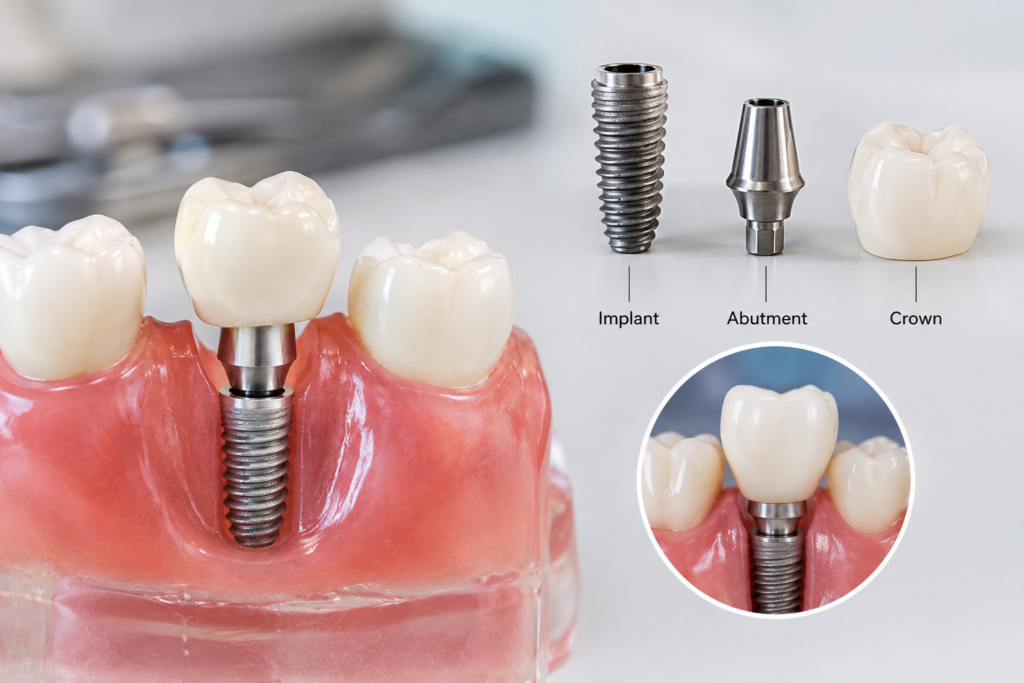
Have you been curious about how a replacement tooth stays attached to an implant? So there’s something small but really important doing this major job, and that small thing is a dental implant abutment. A dental implant replaces the root of a missing tooth, but the implant itself is only one part of the restoration process. A dental implant abutment joins the implant to the crown and gives the visible tooth something solid to hold onto. So the design of that dental implant abutment is really important. Its height, shape, material, and angle all affect how the crown comes up through your gums. It will affect how the restoration is fixed in place and whether there is enough space for the tooth to look and sit the way your dentist has planned.
So choosing the right abutment carefully would be wise to avoid any blunders from happening. Let’s get into the technicalities of how this all works.
| Click here to book an appointment with Delatte Dental in Mansfield, VIC |
What Does a Dental Implant Abutment Do?
A dental implant abutment is the part of the implant that is buried in the jawbone.
After placing a dental implant in your jaw, one of the replacement teeth that is placed will be connected to the implant through a piece called an abutment. After implantation, when the gum has healed, the implant serves as the foundation it rests upon for the crown.
The abutment is not seen above the gumline, but it does contribute to the position into which the crown will fit; it may influence its fit with the gumline and its natural appearance. The proper design also assists the dentist in achieving an efficient fit.
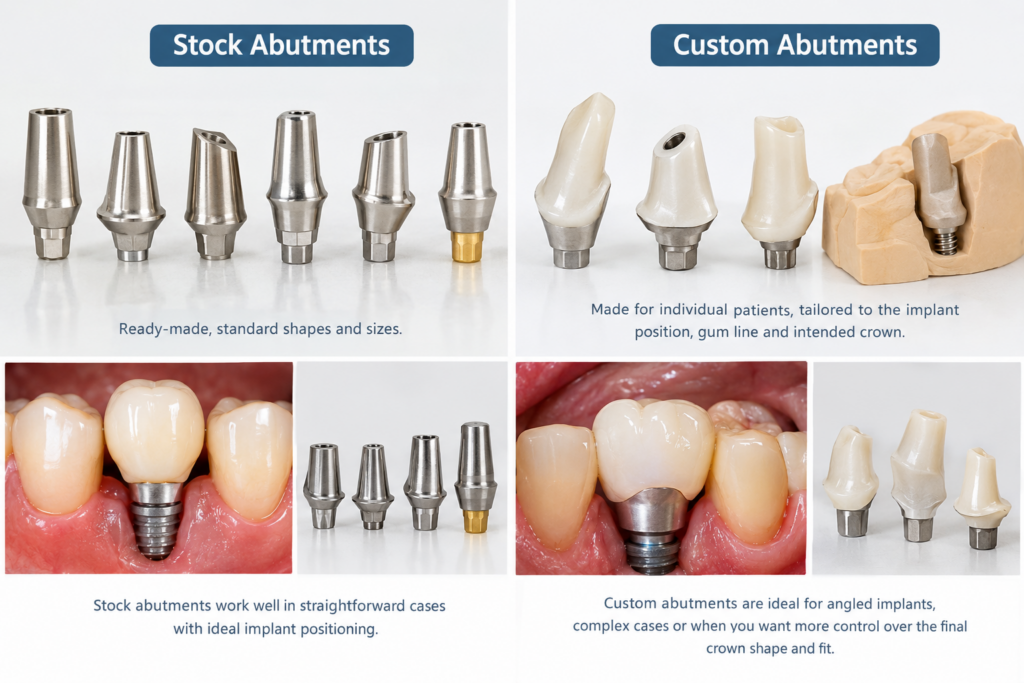
Stock vs Custom Dental Implant Abutments
Stock or custom abutments can be utilised based on the site location of the implant and the type of crown to be fitted.
Stock abutments are ready-made, ready-to-install in standard shapes and sizes. They are easily available and can be successful when the implant is in a position that makes it easy to put the crown in place without any special adjustments.
Custom abutments are made for an individual patient. They can be shaped as per the placement of the implant, the gum line around the implant and the intended crown. This may be helpful if there is an angle of the implant that the dentist would not prefer or if there is a need to increase the control of the shape of the finished tooth.
Both are not necessarily all the better for everyone. Before deciding on a design, the dentist takes into consideration the position of the implant, available space, crown appearance, and more.
Titanium and Zirconia Abutments
The materials often used for dental implant abutments are titanium or zirconia. The properties of the materials are different, and are dependent on the clinical situation.
Titanium abutments are widely used because, for one, the material is strong and is compatible with the dental implant systems. It is frequently an appropriate choice in regions where performance and longevity are the most important criteria.
Zirconia abutments are ceramic components that are tooth coloured. They can sometimes be helpful in places where the gums are thin or where the colour of the material would show through.
The dentist takes into account the placement of the implant, the thickness of the gum tissue, the material of the crown and the forces on the tooth. Depending on the person’s restoration needs, the best material to use is determined.
Screw-Retained vs Cement-Retained Crowns
Getting the dental implant crowns attached to the abutment can be done in 2 different ways: with a screw and with dental cement.
Uses a screw-retained crown that is held onto the implant assembly with a small (secure) screw. The dentist can easily take the crown out later if it needs repair or maintenance. Screw access opening is filled, it is necessary to carefully increase the position of the hole.
With a cement-retained crown, the crown is held by the cement over the abutment. This can be effective in creating a natural appearance without a screw access opening. However, care must be taken to remove all excess cement around the periphery of the gum line; otherwise, there could be some irritation along the gum line.
Both approaches offer some benefits. It will depend on where the implant is placed, the design of the crown, how easy it will be to maintain in the future, and the dentist’s treatment plan.
Plan Your Dental Implant Abutment Procedure at Deletite Dental, Mansfield, VIC
The connection between the implant, abutment, and crown influences the final shape of the tooth, how the restoration is secured, and how it can be maintained over time.
At Delatite Dental, patients can discuss dental implant abutment and replacement tooth options with the dental team at 48 High Street, Mansfield VIC. A consultation allows the dentist to assess the individual situation, explain suitable restorative options, and discuss the factors that influence treatment planning.
To arrange an appointment, call (03) 5775 2277 or visit the Deltite Dental website.
Frequently Asked Questions (FAQs)
Q.1. What is a Dental Implant Abutment?
A dental implant abutment may be defined as the connecting device that joins the dental implant fixture inside the jawbone to the tooth restoration (crown, bridge, etc.) that is mounted on top of it.
Q.2. Does Each Dental Implant Require an Abutment?
The abutment is used in combination with the fixture to hold the artificial teeth. A conventional dental implant usually consists of two parts: the fixture and the abutment. However, there are implant systems that utilise a one-piece design or where the abutment is integrated into the restoration. The specific connection method depends on the type of implant and restoration.
Q.3. Is a Custom Abutment Better Than a Stock One?
It depends on the situation. In some cases, a stock abutment can be used successfully if it has the proper shape to satisfy the patient’s anatomical and esthetic needs. On the other hand, a custom abutment may be indicated when a more esthetic or functional result is required.
Q.4. Is the Shape Of The Abutment Important?
Yes. The abutment should be contoured in such a way that allows for an accurate fit of the dental restoration and esthetic harmony with the surrounding soft tissues. The final appearance of the implant-supported restoration also depends on the location of the implant, the condition of the patient’s soft and hard tissues, the material used for the restoration, and its shape.
Q.5. Can I Remove My Dental Implant Crown?
It depends on how the restoration is attached to the abutment. If your crown is screwed on top of the abutment, it can be removed relatively easily by simply unscrewing it. However, if it is cemented, it may require more effort to remove. In some cases, the restoration must be destructively removed.