
The shape of your gums and the bone underneath them can change over time. When that happens, dentures that once fit well can start to feel loose or uncomfortable. You don’t always need a brand-new set of dentures when the fit gets worse. Denture relining vs. rebasing comes down to how much of the existing denture needs to be changed to restore its fit and function. Both options can improve the fit of a denture you already have, but one involves a different amount of work. Relining only updates the part of the denture that sits against your gums. Rebasing replaces the whole pink base of the denture (the part that holds the teeth).
Understanding the difference makes it clearer why a dentist might recommend one procedure over the other.
What is Denture Relining?
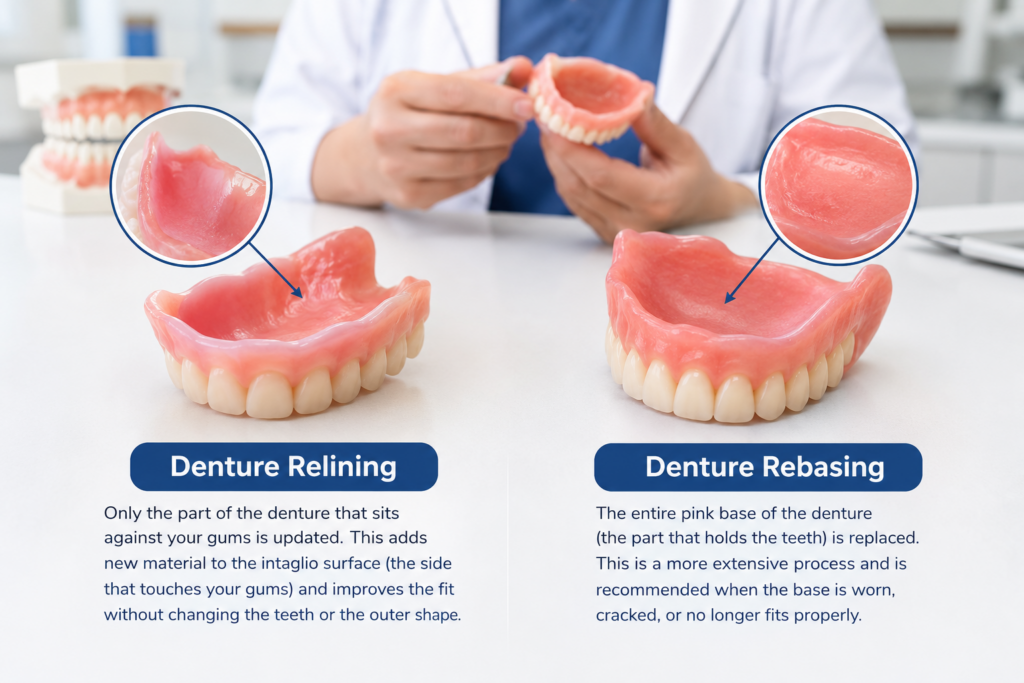
A denture relining occurs when an existing denture is used with additional material on its inner surface. This is the inner face that is against the gums and the gum tissues.
As the denture ages, the underlying jaw bone may slowly deteriorate (residual ridge resorption). As supporting tissues reshape, the denture doesn’t fit as tightly. With the reshaping of the supporting tissues, gaps form between the denture and gums. The denture can then shift during meals and/or while talking, or can exert unequal pressures over parts of the denture.
Relining is done when the fitting surface needs to be resculpted to fit the mouth’s contour at the moment. The original denture base with a large amount of the artificial teeth still present.
There are two ways that dentists can do this:
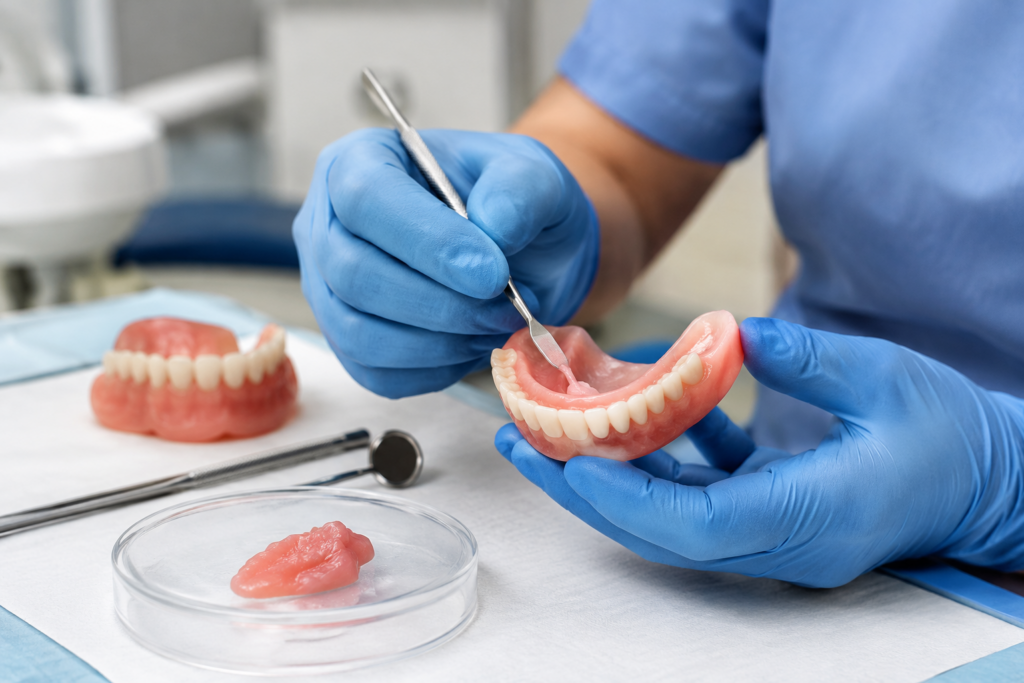
Direct relining: The dentist puts in an appropriate reline material and fits the denture in the mouth. This is usually done in the Dental Office.
Indirect relining: An impression is taken, and then the denture is sent to a dental lab for the new denture fitting surface to be processed.
This selection will be determined by the condition of the denture, the degree of correction needed, and the denture material involved.
Mild dentine deterioration (when the denture base and teeth are still in good condition but fit against the gums is poor) is usually the type of dentine deterioration for which relining is recommended.
What Is Denture Rebasing?
Denture rebasing is a procedure in which the entire denture base is replaced with a new one, leaving the existing teeth intact, if they are in good condition.
The base is the part of the denture upon which the artificial teeth are mounted and which is placed on the oral tissues. In the case of an acrylic denture, this is the pink part, which usually looks like pink gums.
A dentist can recommend rebasing if the existing base is irreparable or if it is more cost-effective to replace it with a new one, instead of trying to refinish the old one.
During the procedure, the dentist will take an impression and use the old denture to make a model of a new base. A dental laboratory then finishes processing the new base so that it fits around the existing teeth.
Even though the existing teeth are left intact, they still have to be examined by a dentist. If they are worn, improperly shaped or positioned, rebasing will not correct these problems.
Therefore, rebasing is not a conservative procedure that only replaces the old denture base. Instead, it also makes significant changes to the entire denture.
Denture Relining vs. Rebasing: What Is the Difference?
The main difference is how much of the denture is replaced
| Feature | Denture Relining | Denture Rebasing |
| What changes? | The inner fitting surface | The entire denture base |
| What stays? | The existing base and artificial teeth, where suitable | The existing artificial teeth, where suitable |
| Main purpose | Improve adaptation to the gums | Replace the existing base material |
| Typical reason | The denture has become loose as the mouth changes shape | The base needs replacement, but the teeth can still be used |
| Where is it done? | At the clinic or in a dental laboratory | Generally in a dental laboratory |
When is it time for a new Denture?
Relining and rebasing are means of prolonging the service life of an old denture, but are not solutions to all the problems.
A new denture may be indicated if there is extensive damage to the base surface of the denture and cannot be sufficiently repaired or rebased or by the presence of badly worn dentures and a need for significant bite adjustment.
There may be significant changes in the fitting surface that involve more than just the jaw and gums. In such instances, the dentist must determine if any adjustments to the existing denture will provide sufficient support, stability and function.
No set timing is given for the replacement, rebase and relining of all dentures. This is a decision that is based on clinical findings and condition of the particular denture.
Do not attempt to reshape a denture if it is loose. In some cases, denture adhesives may be used, but they can only help with poor fit… they cannot improve the fit. Looseness or discomfort that continues should be suspected to be dental.
Get Your Dentures Assessed at Delatite Dental
If your denture no longer fits as it should, a dental examination can help establish whether relining, rebasing, repair or replacement is the most suitable option.
At Delatite Dental, our team provides dental care in Mansfield, Victoria, including assessments for dentures and tooth replacement. We can examine your existing dentures, check the condition of your gums and discuss the options available for your needs.
Visit us at 48 High Street, Mansfield VIC 3722, or learn more about our dentures and tooth replacement services.
Frequently Asked Questions (FAQs)
Q.1. Does denture relining change the artificial teeth?
No, relining does not alter the artificial teeth. It changes the material to which your gums are attached. Your existing teeth and the majority of the base are left intact if their condition is satisfactory.
Q.2. Is rebasing better than relining?
Not necessarily. Relining is usually applied when a fitting surface of the denture needs to be adjusted. Rebasing replaces the entire base. The decision depends on the condition and fit of the denture.
Q.3. Can my loose dentures be relined more than once?
Yes, they can be relined several times in cases when it is indicated. However, such procedures are not always the best option. Your dentist can advise whether relining, rebasing or replacing the dentures will be the best option.
Q.4. How do I know if my dentures need relining or rebasing?
The only reliable way to know for sure is to visit your dentist. A professional will be able to determine the condition of the base material, the fitting and the state of the artificial teeth before suggesting any treatment.