
Social media has made individuals look at their smiles more closely than ever. People have become more analytical and self-conscious about how they look and feel. So it is evident that this demand to “look aesthetically pleasing” on the internet has fuelled a massive demand for cosmetic dentistry worldwide. Fillers, Face Tune, face & teeth whitening products, and orthodontic treatments like clear aligners to get that “perfect smile” are the new norm now. For many adults in Mansfield, Mount Buller, Benalla, Euroa, and beyond, doing these treatments goes far beyond the trending hashtags and viral look. Some people are genuinely in need of Porcelain veneers. Why? To start with, darkened front teeth, thinning enamel, or uneven edges. And apart from the direct results you see on Instagram, the process itself includes consultation, mock-ups, lab work, and long-term aftercare.
At Delatite Dental in Mansfield, VIC, our team will guide you through everything from start to finish. Read this blog post to learn how it goes.
Step 1- The Initial Consultation
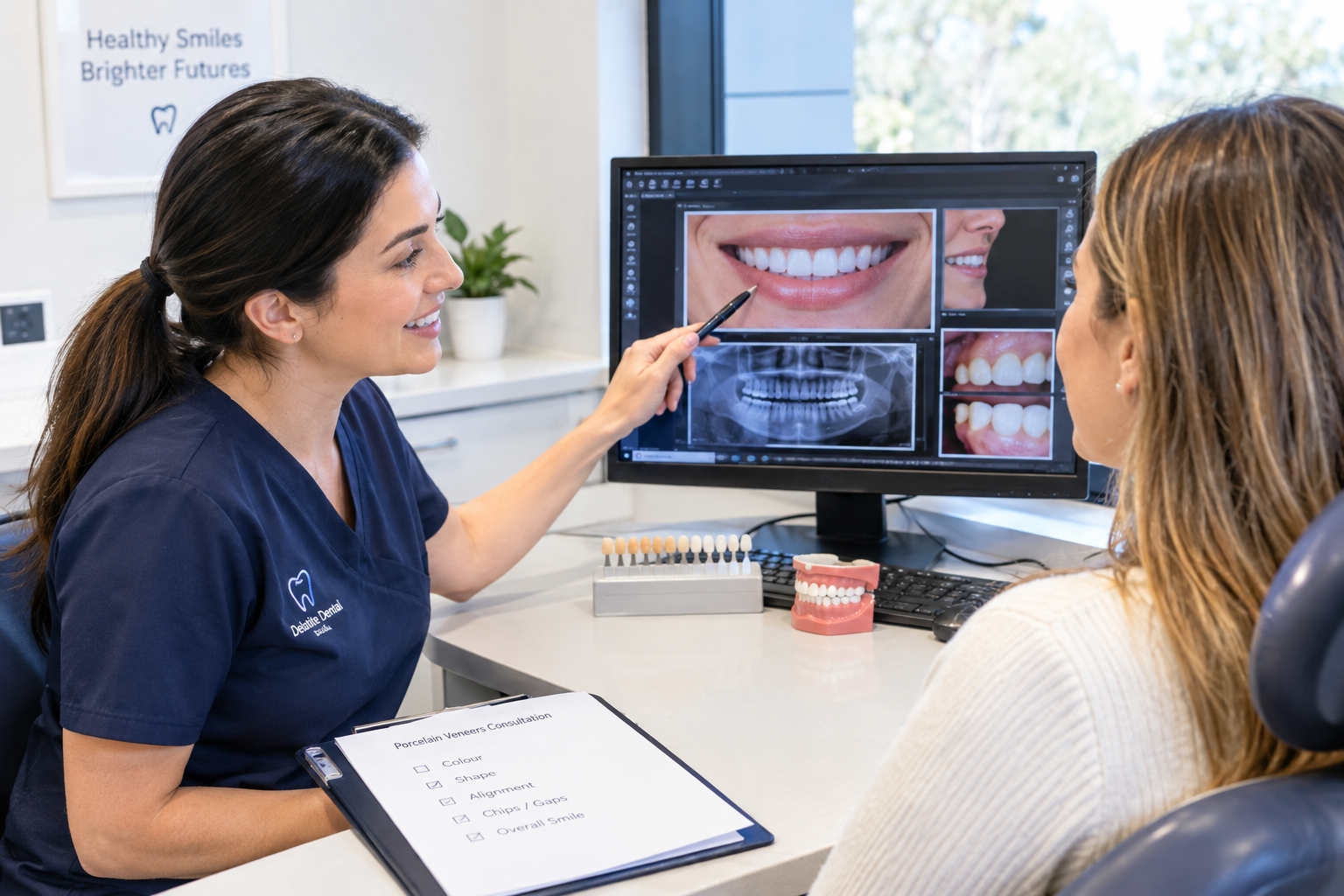
The first step is a consultation that focuses on patients’ needs and whether porcelain veneers are a suitable option for them or not. The first appointment is all about understanding the basics and also letting patients know what the whole process is going to look like.
Our professionals will:
- Listen to the patient’s concerns about colours, shape, alignment, chips, gaps, and so on.
- Examine the teeth and gums because those things affect whether veneers are appropriate for you.
- Take photographs and X-rays where needed, so the assessment is based on clear records.
- Discuss whether veneers, bonding, whitening, orthodontics, or a combination of treatments would be a good choice.
Step 2 – Smile Design & Treatment Planning
If veneers are appropriate, then the next step is planning how they will look and how they will function in the mouth. The next step involves planning both appearance and function.
It may include:
- Digital or physical mockups so the patient can preview shapes.
- Discussion of shade, translucency, and how natural the result should look.
- Decision about how many teeth to treat
Step 3 – Tooth preparation
A common concern about porcelain veneers is how much of the patient’s tooth structure has to come away to make way for them. In most cases, preparation of the recipient teeth only extends down into the enamel by 0.3- 0.7 mm, depending on aesthetic requirements and the original position of the tooth. Some cases allow for minimally invasive or even zero-preparation veneers, while others require more conservative removal of enamel to achieve a suitable shape and shade.
Preservation of enamel wherever it is a factor in the longevity of the restoration. Local anaesthetic will be used to ensure comfort during tooth preparation. Temporary veneers may be placed if required whilst permanent veneers are being made by the dental laboratory.
Step 4 – Impressions or Digital Scans and Laboratory Fabrication
With your teeth prepared to receive porcelain veneers, the next stage is to provide the dental laboratory with an accurate record of the prepared teeth.
This may take the form of:
- Either traditional dental impressions, taken with a special tray and material
- Or digital scans of the prepared teeth, taken with a special intraoral camera.
The laboratory will use whichever method has been agreed, and will fabricate your porcelain veneers according to the records and shade guidance provided. It is normal for patients to be wearing temporary veneers if these have been placed. They can expect to wait between 1-3 weeks for the permanent veneers to be returned from the laboratory.
Step 5 – Fitting Appointment
When the porcelain veneers return from the laboratory, the fitting appointment can begin. This will focus on trying in the veneers to check colour, shape and fit, and to bond them to the prepared teeth.
Our team will:
- Try in the porcelain veneers with water or try-in paste to assess how the colour and shape relate to your smile
- Make any adjustments to the veneers for comfort and to ensure a harmonious bite.
- Ensure that you are happy with the aesthetics before bonding the veneers in place.
Once you are happy with the appearance of the veneers, they will be bonded in place using resin cement. This material is light-cured to ensure an effective bond, and any excess material is removed to give a smooth finish to the biting surface and edges of the veneer. The fit and your bite will be checked and adjusted where necessary to ensure comfort and aesthetic harmony.
Step 6 – Review and fine-tuning
A review appointment will usually be scheduled 1-2 weeks after bonding, with further reviews with your regular dental practitioner to check on the health of your gums and bite as part of your standard dental check-ups.
Our team will:
- Check the condition of the gums around the veneers
- Check that the bite is comfortable
- Address any concerns regarding sensitivity or adaptation
- Discuss continued maintenance with you
Most patients find that they settle quickly to life with porcelain veneers. Any concerns regarding discomfort, rough edges, or disruption of the occlusion should be raised at the earliest opportunity.
Take The Next Step in Your Porcelain Veneers Journey
If you are considering porcelain veneers or any cosmetic dentistry process in Mansfield, feel free to reach out to Delatite Dental in Mansfield. We will start with the initial consultation and prepare a roadmap for you. We’ll discuss which treatments are the best options for you and give you realistic expectations about how the results will look.
Book an online consultation or call us at (03)5775 2277 to book your appointment.
Frequently Asked Questions (FAQs)
Q.1. How many appointments are required for porcelain veneers?
Most cases require a minimum of two appointments: one for consultation, preparation, and impressions/scans, and one for fitting. There may be additional appointments for review.
Q.2. Do porcelain veneers look natural?
When done correctly, porcelain veneers should look completely natural and enhance the appearance of your smile without being too white or artificial.
Q.3. How much of my tooth will be removed for veneers?
The amount of tooth reduction depends on the type of veneer and your dental condition. But it typically ranges from 0.3- 0.7 mm on the enamel layer for traditional veneers.
Q.4. How long do porcelain veneers typically last?
According to a systematic review, porcelain laminate veneers have a 95% survival rate after 10 years with proper maintenance in appropriate cases.
Q.5. Can I get my veneers replaced if they chip or come off?
Porcelain veneers can often be replaced individually if they become damaged or detached. If you experience any issues with your veneers, it’s best to contact your dentist as soon as possible.
Q.6. Do I need a night guard if I get porcelain veneers?
If you have a habit of grinding or clenching your teeth at night, then yes, it’s highly recommended that you get a custom-made night guard to prolong the lifespan of your veneers while also protecting your natural teeth.
Q.7. The next step for porcelain veneers in Mansfield?
If you’re interested in porcelain veneers in Mansfield or the High Country, the first step is to schedule a comprehensive consultation at Delatite Dental. We will examine your teeth and determine if veneers are right for you while also discussing realistic expectations for cosmetic results within an appropriate timeline.