
Sensitive teeth are one of the most common complaints among dental patients. A cold drink can expose a tooth that has been quietly developing a problem for months. But it’s not like every tooth sensitivity you get is caused by cold drinks only. It can indict numbers of underlying problems, like decaying which will need root canal treatment. In some cases, causes are less serious, like exposed dentine, gum recession, or worn-out enamel. Several unrelated dental issues can produce a nearly identical response, similar to tooth sensitivity to cold. It could be a cracked tooth or a tooth that has just recently become temporarily sensitive. Or an inflamed pulp can also produce a similar pain. Even a tooth with no visible hole, crack, or discolouration can sometimes be the cause of the discomfort.
But today we are focusing on why a tooth reacts a certain way to cold. Dr David Huang approaches these cases as part of general restorative dentistry. He looks past the symptoms themselves to determine whether the problem is coming from the tooth surface, the dentine, an existing restoration, surrounding tissue, or the pulp inside. Dr Hunag will help you explain what different patterns of cold sensitivity can indicate and how dentists identify the exact source of the pain.
Tooth Anatomy and Cold Sensitivity
A tooth is made up of several layers, and each layer has a different function.
Enamel: The first layer is enamel. Enamel is the hard outer covering of the visible part of the tooth. It protects the layers beneath it, but it does not contain nerves of its own.
Dentine: The next layer is dentine. Dentine is located beneath the enamel. It is less mineralised than enamel and contains tiny microscopic tubules. When dentine is exposed, temperature changes can trigger tooth sensitivity.
Pulp: Pulp is at the centre of the tooth. It contains nerves, blood vessels, and connective tissues. This is the part where the source of the pain can become more complex. If the pulp becomes inflamed, the sensation caused by the cold is no longer ordinary surface sensitivity.
So when you say cold water makes your tooth jumpy, there are several layers to it. There can be many triggers, and we will explore it all in the rest of the blog.
How Long the Sensitivity Lasts
So what happens once the cold stimulus is gone? Even two different patients experiencing similar symptoms can be dealing with two different problems. The timing of the pain is one of the details we use when evaluating the condition of the pulp. One common pattern is pain that is sharp but fades quickly. This pattern can be consistent with dentine hypersensitivity or a milder form of irritation within the pulp.
For example, if cold water touches the tooth, it causes a brief sting, and the sensation disappears almost as soon as the cold is gone. Another pattern is pain that continues after the cold is removed. A response to cold that lingers can be more concerning because it may suggest inflammation of the pulp. The lingering response to temperature is an important diagnostic factor when evaluating pulp inflammation.
Another important change is the pain that appears even without a cold stimulus. That is another detail worth bringing up during an examination. Pain that starts on its own rather than only after a specific trigger can suggest a different stage of pulp-related disease and should be assessed by a dentist.
| What You’re Experiencing | What It Could Point Toward |
| Brief, sharp cold sensitivity | Exposed dentine or milder pulpal irritation |
| Several teeth sensitive to cold | Dentine sensitivity, recession or enamel wear |
| One tooth suddenly becomes sensitive | Localised problem such as decay, crack or restoration |
| Cold pain that lingers | Pulp inflammation needs investigation |
| Cold sensitivity plus biting pain | Possible crack or restoration problem |
| Sensitivity after recent dental work | Temporary pulpal irritation or restoration-related issue |
| Cold sensitivity with swelling | Possible infection or abscess |
| Pain without any obvious trigger | Deeper pulpal or other dental problem may need assessment |
When Cold Sensitivity Starts Pointing Toward the Pulp
The pulp is the living centre of the tooth, and it contains nerves, blood vessels and connective tissue. When the pulp becomes inflamed, dentists may refer to this as pulpitis.
A. Reversible pulpitis: Reversible pulpitis occurs when the pulp is inflamed but still has the potential to heal.
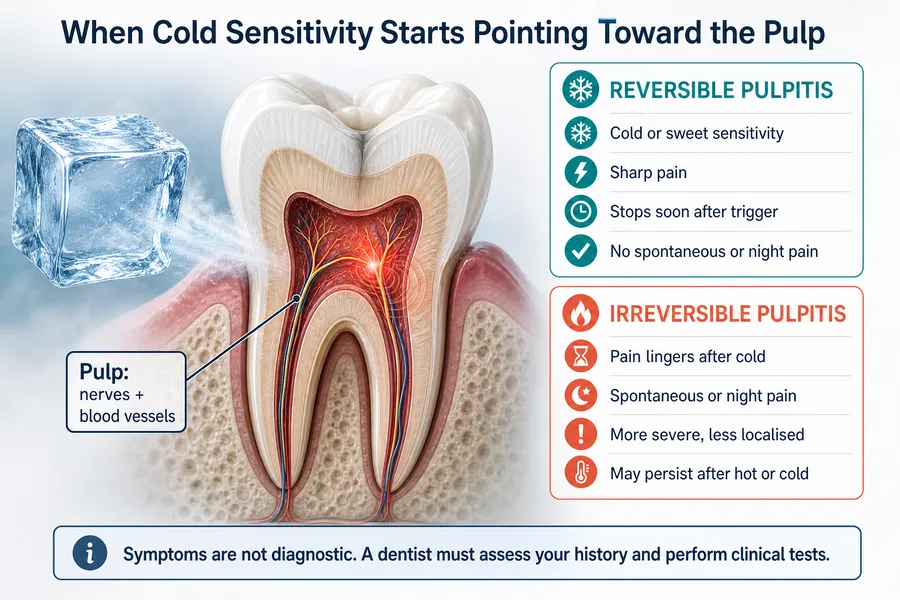
Common symptoms may include:
- Sensitivity to cold or sweet foods
- A sharp pain
- The pain ceasing soon after exposure to the trigger
- No spontaneous pain
- No pain occurring at night
Possible causes may include: early decay, recent dental work, exposed dentine, or a high bite (when a tooth receives excessive force).
B. Irreversible pulpitis: Irreversible pulpitis refers to pulpitis that is more advanced and unlikely to heal.
Symptoms may include:
- Pain lingering after exposure to cold
- Spontaneous pain
- More severe symptoms
- Pain occurring at night
- Pain persisting after the trigger has been removed
- Pain that is not localised
- Pain persisting after exposure to hot or cold
It is important to note that these symptoms are not definitive of any diagnosis. A dentist, such as Dr David Huang, would need to review your pain history and perform a clinical assessment and appropriate tests to confirm any diagnosis.
How Dr David Huang Works Out Where the Pain Is Coming From
There is no definitive test for localising tooth pain. Diagnosis usually requires a process of elimination, reviewing:
1. Pain History
Dr David Huang may ask you several questions, including:
- Which tooth are you referring to?
- Do cold, hot, or sweet foods trigger your pain?
- How quickly does the pain occur?
- How long does it last?
- Do you have pain that occurs without an obvious trigger?
- Does it hurt when you bite down?
- Does it hurt when you release a bite?
- Does it wake you up at night?
- Have you recently had a filling placed?
- Have you had any trauma or a heavy bite on the tooth?
2. Visual Examination
The tooth and surrounding tissues may be examined for:
- Decay
- Cracks
- Enamel wear
- Gum recession
- Exposed roots
- Fractured fillings
- Gaps around restorations
- Discolouration
- Swelling or drainage
- Cold or vitality testing
A controlled cold stimulus may be used to determine how the tooth responds compared to adjacent teeth. This helps ascertain whether there is any pulpitis and its severity. It is an important test that should be used in conjunction with other diagnostic tools.
3. Cold Or Vitality Testing
A controlled cold stimulus can help compare the suspect tooth with neighbouring teeth. The dentist observes whether the tooth responds, how strongly it responds and how quickly the sensation disappears.
4. Percussion (Tapping On The Tooth)
The tooth may be tapped to examine whether there is any sensitivity in the surrounding tissues, which can occur with inflammation.
5. Bite Test
A bite test may be used to identify a crack, especially if the pain occurs when biting down or releasing the bite.
6. Periodontal Examination
The gums around the tooth may be examined to rule out any periodontal causes for your pain.
7. X-Rays And Other Imaging
X-rays may be taken to identify:
- Decay between teeth
- Issues around the root tip
- Bone loss
- Problems beneath a restoration
- The shape of the tooth
- The presence of infection
- Other relevant structures
Imaging may also be used if the dentist suspects there is a problem that cannot be identified clinically.
Why Dentists Do Not Jump Straight to a Root Canal
Cold sensitivity is not a definitive indicator for needing a root canal. The appropriate treatment will be determined by the cause of your sensitivity. Treatment options may include:
- Desensitising products
- Fluoride treatment
- Advice regarding brushing pressure and technique
- Reducing acidic foods and drinks
- Treatment for gum recession
- Restoration of a fractured tooth
- Repair or replacement of a restoration
- Removal of decay
- Root canal treatment if the pulp is irreversibly inflamed
The treatment will be based on the diagnosis rather than the symptoms. For example, a tooth with exposed dentine may benefit from desensitising treatment, whereas a tooth with decay may require restoration. A tooth with irreversible pulpitis may need root canal treatment.
We’re not trying to scare you; symptoms that persist or change are usually best investigated rather than ignored. Early diagnosis may help prevent a small problem from becoming a bigger one.
Dr David Huang and Restorative Care in Mansfield
Dr David Huang is a graduate of the University of Melbourne, with a Bachelor of Biomedicine and a Doctor of Dental Surgery. He has worked extensively with Smile Squad, helping patients manage their dental pain and restoring their oral health.
He is a firm believer in the importance of thorough diagnosis in conjunction with effective but simple communication. He also likes to keep his skills up to date with respect to all aspects of dentistry, including restorative care.
Cold sensitivity is a good example of why restorative dentistry is not as simple as just filling a hole. Before any restorative care can commence, the dentist has to work out what is causing the pain and what structures are involved.
A cold-sensitive tooth may need desensitising, restoration, repair or more involved treatment. Dr David Huang can work with you to identify the cause of your sensitivity and the most appropriate treatment for your situation.
Book a Consultation with Dr David Huang for Tooth Sensitivity
Now that we’ve concluded that tooth sensitivity can have a lot of triggers. So if you’re dealing with tooth sensitivity, it could be anything from cold or warm stimulus or any underlying issues. Stay alert for symptoms, which can help your dentist understand and figure out the problem quickly. A proper dental examination with Dr David Huang can help check for exposed dentine, gum recession, decay, cracks, restorations, and pulp inflammation.
Book a consultation in Mansfield, VIC for tooth sensitivity or other dental issues.
Frequently Asked Questions (FAQs)
Q.1. Why are my teeth sensitive?
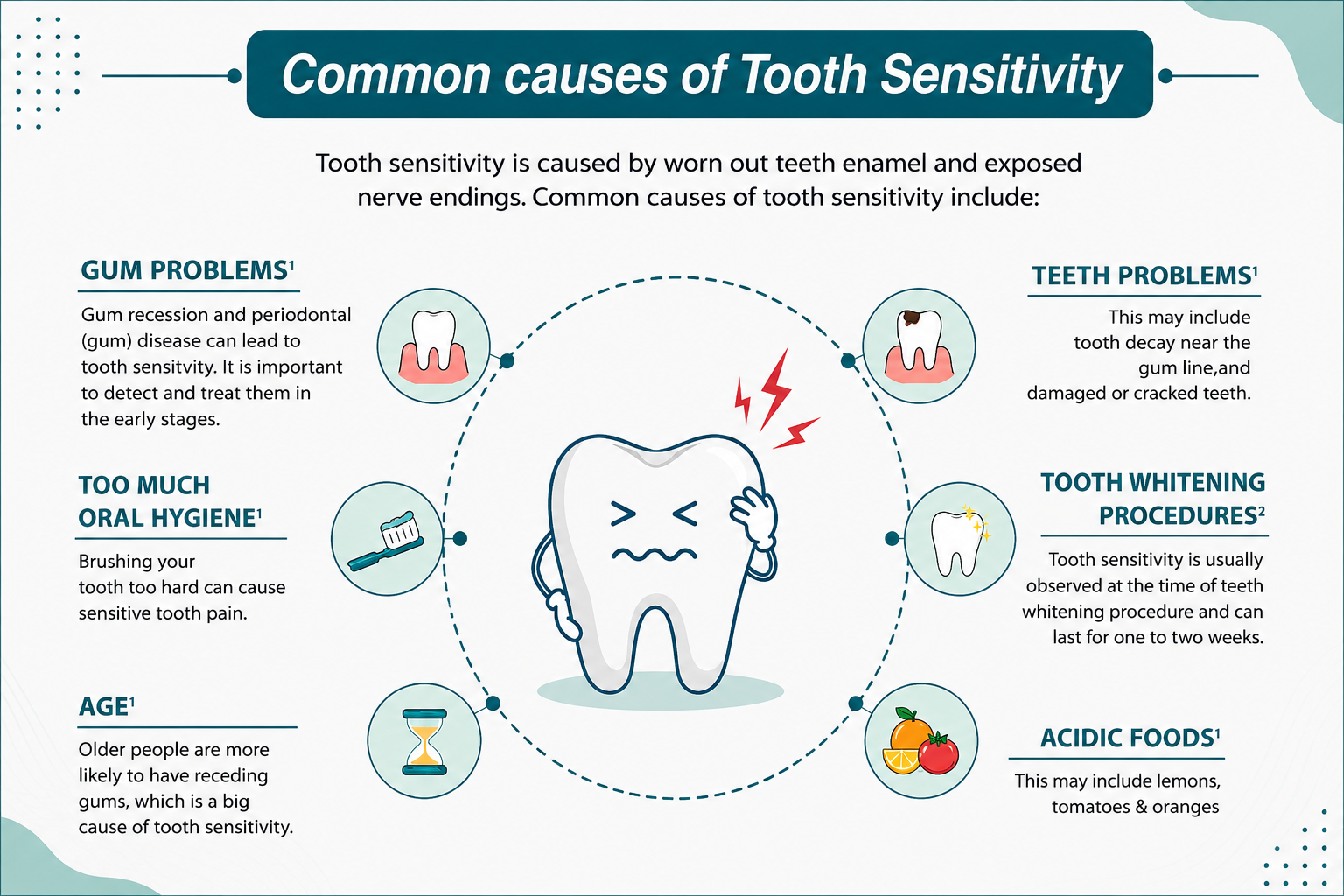
There can be quite a few reasons for that. Exposed dentin can most likely be the reason. Dentin is the tissue that makes up the core of each tooth, which is covered by a protective coating of enamel. When this enamel wears away or decays, the dentin becomes exposed and receptive to sensations, including pain. Dentin exposure and sensitivity also occur when roots are exposed due to gum recession.
Q.2. When does tooth sensitivity usually occur?
You may experience tooth sensitivity, or dentin hypersensitivity, after eating cold or hot foods, drinking cold or hot liquids, or breathing cold air.
Q.3. What causes dentin hypersensitivity?
Causes of dentin hypersensitivity include brushing too hard, which wears away enamel, and gum disease. Other causes include cracked or chipped teeth and grinding or clenching your teeth. Medical conditions like bulimia may also lead to exposed dentin. Your diet may also play a role. Consumption of acidic foods and drinks, such as citrus fruits and carbonated beverages, can chemically dissolve enamel over time, resulting in exposed dentin.
Q.4. What can increase dentin hypersensitivity?
Some toothpaste brands contain abrasive ingredients that may wear away enamel. Ingredients found in some whitening toothpastes and bleaching treatments may increase tooth sensitivity as well.
Q.5. How do I know when it’s time to see a dentist?
If your teeth are highly sensitive for more than three or four days and they react to hot and cold temperatures, it’s best to get an evaluation from your dentist.
Q.6. How does a dentist determine dentin hypersensitivity?
A dentist can gauge the severity of your sensitive teeth by using an air test. The dentist sprays air across each area of your teeth to pinpoint the exact location of sensitivity.
Q.7. What can the dentist do to treat dentin hypersensitivity?
Your dentist will examine your teeth, look for causes of sensitivity, and make treatment recommendations. If sensitivity is associated with clenching and/or grinding, your dentist may recommend a mouth guard. Dentists have a variety of treatments for dentin hypersensitivity. Home products include desensitising toothpastes and mouth rinses. In-office procedures include application of desensitising agents or protective sealants.
Q.8. What can I do to improve tooth sensitivity?
Practice good oral hygiene to maintain healthy teeth and gums. Use a soft-bristled toothbrush and avoid brushing your teeth too hard. And watch what you eat: Avoid acidic foods and drinks.