
Mild loss around the teeth is so common in adults that dentists use a standard measurement system specifically to track it. It’s called periodontal probing. It usually takes about two minutes and gives the dentist more information about what is happening under the gum line than a visual examination alone can provide. And don’t worry, bone loss around teeth doesn’t mean your teeth are gonna fall off tomorrow. The possibility is that something is irritating the tissues and bone around the teeth for long enough to cause measurable change. Once that is known, there is often a meaningful amount that can be done about it.
Bone loss around teeth usually indicates that the gum disease has moved past simple inflammation and has begun affecting the bone that supports the teeth. You won’t lose your teeth right away. But the condition needs a proper assessment and a clear treatment plan. Lost bone does not regenerate by itself, but the disease process can often be stopped or slowed. With appropriate treatment and ongoing care, many people keep their natural teeth for years even when some bone loss is already present.
This blog post explains everything you need to know about bone loss around teeth and how Dr Angela Nguyen at Deltire Dental, Mansfield can help you with that.
| Book Your Slot Here |
How Bone Loss Around Teeth Develops
Teeth are not held in place by the gum tissue alone. They are supported by a group of structures called the periodontium. That includes the gum tissue, the periodontal ligament, and the alveolar bone that surrounds the tooth roots. In a healthy mouth, that bone remains at a stable level around each tooth and provides firm support. When gum disease moves from gingivitis to periodontitis, the body’s inflammatory response begins to affect these deeper supporting tissues. Over time, the bone holding the teeth in place can be broken down. When a dentist reports bone loss around the teeth, they are describing a reduction in this supporting bone,m usually caused by long-standing periodontal disease. This is different from the early stage of gum disease. In gingivitis, the gums may look red, feel swollen, and bleed easily, but the bone level remains normal. Once bone loss can be seen on X-rays, the diagnosis moves into the periodontitis category.
How Dentists Identify And Measure Bone Loss
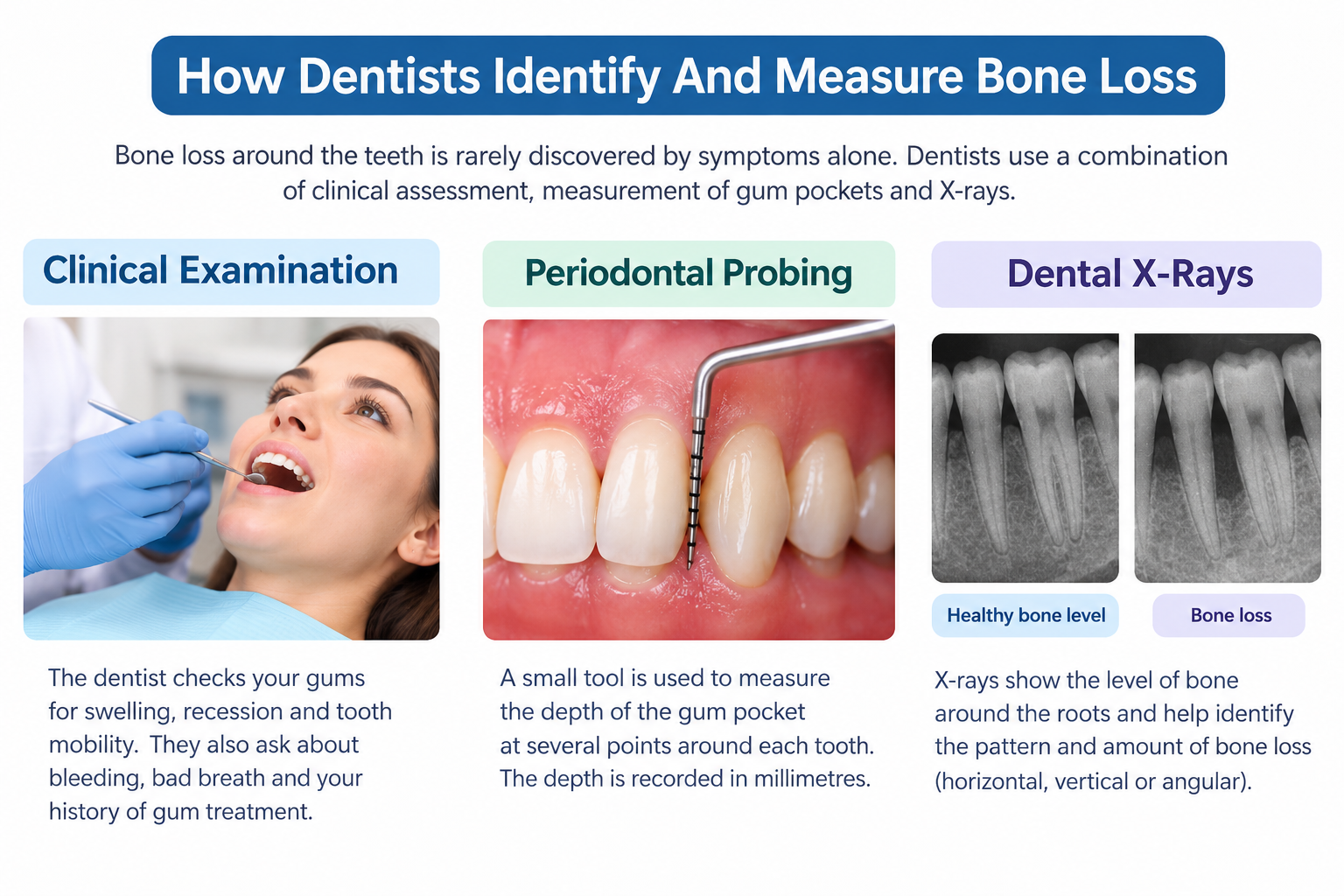
Bone loss around the teeth is rarely discovered by symptoms alone. Many people experience few or no symptoms even when significant bone loss is present. Dentists use a combination of clinical assessment, measurement of gum pockets and X-rays.
Clinical Examination
The dentist or hygienist will examine the colour and contour of your gums, checking for swelling, recession and mobility of the teeth. They will also ask about bleeding on probing, bad breath and any history of gum treatment.
Periodontal Probing
A small instrument called a periodontal probe is used to measure the depth of the space between the gum and the tooth at several points around each tooth. The depth of this pocket is recorded in millimetres for each tooth at six sites.
Healthy gums typically have pocket depths of one to three millimetres. If the attachment between the gum and tooth is lost, this pocket can deepen, and readings of four millimetres or greater with bleeding on probing indicate periodontal disease. The pattern and depth of these pockets can give an indication of the possible loss of attachment and underlying bone loss.
Dental X-Rays
An X-ray can indicate the level of bone around the roots of the teeth relative to neighbouring teeth. In a healthy mouth, bone is usually found at a comparable height around the roots. In periodontitis, this level can appear lower. The dentist also looks for patterns of bone loss, particularly:
- Loss of bone in a horizontal direction (ie, relatively evenly across an entire area of teeth)
- Loss of bone in a vertical or angular direction (ie, more prominent on one particular side of a tooth)
- The percentage of the root length affected by loss of bone attachment, typically categorised as less than one-third, one-third to half, or more than half.
The diagnosis of periodontitis is based on findings from both probing and X-rays. It is uncommon to be told that you have bone loss if your teeth feel fine and look fine in the mirror.
Gingivitis Versus Periodontitis, Where Does Bone Loss Fit In?
It can help to understand where bone loss fits into the broader spectrum of gum disease.
Gingivitis is the mildest form of gum disease, characterised by gum inflammation caused by plaque bacteria. Symptoms include bleeding gums during brushing, red, swollen gums and discomfort. There is no destruction of the supporting bone or the periodontal ligaments (which connect the tooth to the surrounding bone). Gingivitis can typically be reversed with improved oral hygiene and scaling and cleaning (professional cleaning) by a dentist or hygienist.
Periodontitis occurs when the gums and periodontal ligaments become inflamed and affected, and the supporting bone begins to be lost. This can be seen on dental X-rays as areas of reduced bone density or even absent bone. As the condition progresses, periodontal pockets (pockets that form between the gums and teeth) deepen, gums may recede, and teeth may become loose in the later stages. While periodontitis cannot be “cured” in the traditional sense, it can be effectively managed and controlled with appropriate treatment.
Gingivitis is the mildest form of gum disease. If your dentist has mentioned something to you about bone loss, you are now beyond the realm of gingivitis and into the world of periodontitis.
Stages Of Bone Loss Around Teeth
Dentists commonly use a staging system for periodontitis based on the amount of attachment lost relative to the root length of the teeth, how deep the periodontal pockets are, how many teeth are affected, and whether there has been any tooth loss due to the condition.
As a very basic overview, you can consider three main levels or stages of bone loss:
Early Bone Loss
Only a small amount of attachment loss (usually less than one-third of root length) and mild pocket depth increase. Teeth are generally not loose. At this point in the condition, it can typically be stabilised by careful cleaning and maintenance with improved oral hygiene.
Moderate Bone Loss
Bone loss is more marked, frequently representing one third to one half of the root length. Pockets are deeper and more prone to bleeding. There may be loss of gum tissue around the necks of the teeth. Treatment may involve more extensive debridement of the root surfaces, frequently over multiple visits, combined with more regular review and monitoring.
Advanced Bone Loss
There may be more than 50% of root length affected. Teeth may become loose, mobile, and may migrate, or spaces may appear between teeth. Patients frequently find that they chew differently, and some teeth may be unpredictable and unable to be saved. Advanced periodontal disease requires more involved treatment, including extensive periodontal treatment and potentially surgical access to affected sites to thoroughly clean infected root surfaces. Teeth that cannot be salvaged may need to be extracted and replaced.
Not everyone who has a degree of bone loss will progress to an advanced stage of disease. The level of intervention required can be guided by disease stage.
Why You May Feel Fine With Bone Loss
One of the challenges of managing periodontal disease is that patients are frequently surprised to learn that they have a problem, particularly if there is minimal discomfort. Periodontal bone loss around the teeth is virtually always completely pain-free in its early stages and frequently throughout its progression. Many people will notice bleeding with brushing or flossing as the primary symptom, or may not notice any symptoms at all. Discomfort or pain is typically a late-presenting feature, commonly associated with a combination of mobility, abscess formation, and occlusal trauma.
Due to this, X-ray imaging and periodontal probing are critical diagnostic tools that enable us to identify the extent of the disease and formulate an appropriate treatment plan. It is also a key reason why regular dental check-ups are so important. We cannot rely on symptoms to alert us when there is a problem, particularly with conditions such as periodontal disease, where symptoms may only present when irreversible biological damage has occurred.
Can Bone Loss Around The Teeth Be Reversed?
This is an extremely common question and one that does not have a simple answer. The simple fact is that it cannot. Bone that has been lost due to periodontal disease does not regenerate. However, it should be noted that the progression of the disease can frequently be halted and managed with appropriate periodontal treatment and meticulous home care. Many people will have a degree of periodontal disease and a small amount of bone loss without any significant impact on their daily life.
Bone loss around the teeth is frequently localised. With appropriate periodontal maintenance and control measures, people with periodontal disease can look forward to many years of stable, comfortable function without further loss of teeth or significant impact on their quality of life. In rare, restricted circumstances, it may be possible to partially regenerate lost bone with specialist growth factors and grafting materials, depending on the nature and extent of the defect.
How Is Bone Loss Around Teeth Managed?
Management of periodontal disease and resultant bone loss revolves around controlling the infection, reducing pocket depth and maintaining the supportive tissues around the teeth.
The management of periodontal disease and resultant bone loss revolves around controlling the infection, reducing pocket depth and maintaining the supportive tissues around the teeth.
Professional Periodontal Treatment
Scaling and root planing, both above and below the gum level, is the initial step in treating periodontal disease. This process removes the plaque and calculus biofilm from the tooth surface and infected root surfaces within periodontal pockets. Scaling and root planing can sometimes be performed in one visit depending on the extent of disease, but frequently requires a combination of local anaesthetic and multiple treatment sessions.
Following this initial phase of treatment, the gingival tissues are reassessed to determine response to therapy, including pocket depth, bleeding on probing and levels of inflammation in relation to each tooth.
Improved Daily Oral Hygiene Measures
The role of professional intervention in control of periodontal disease and reduction in pocket depth can be maximised by implementing improved self-care measures at home. This generally involves:
- Brushing at least twice daily with a soft-bristled brush, focusing on the gum margins.
- Interdental cleaning on a daily basis using floss, interdental brushes or a water pick (depending on the size of interdental spaces – as advised by your dentist).
- Using recommended dental care products, as advised by your dentist.
The aim of this is to mechanically disrupt the biofilm on a daily basis to prevent it from re-establishing and causing further irritation and inflammation.
Management Of Risk Factors
There are a number of risk factors that can contribute to periodontal disease or exacerbate the condition if present. Controlling these can have a significant impact on disease management. Key risk factors include tobacco/smoking/vaping, diabetes (poorly controlled), certain medications, and systemic conditions such as stress and general health.
Reach Out to Dr Angela Nguyen at Delatite Dental, Mansfield VIC
If your dentist tells you that there is bone loss around your teeth, the next step would be a proper periodontal assessment. The assessment includes detailed gum measurements, a review of X-rays, a discussion of medical history and risk factors, and a personalised plan aimed at stabilising gum health.
Patients from Mansfield and nearby Victorian communities attend Delatite Dental for periodontal assessment and ongoing gum care. Book a periodontal assessment at Delatite Dental today and take the next step toward clearer answers and more confident care.