
Do you have that one friend who can’t stop talking about how painful the whole wisdom tooth journey is? Yeah, that could be you sooner or later. Wisdom teeth are proof that evolution has a sense of humour and absolutely no sense of timing. You might think, “How bad can it be?”...So imagine an ice pack on your face, cheeks swollen like a chipmunk, eating only a liquid diet through a straw for days… blah blah. We’re not trying to scare you, though. Not everyone experiences pain when their wisdom teeth come in or during their wisdom extraction tooth journey. Some people have enough room in their jaw for teeth to emerge without any discomfort.

Wisdom teeth are the only part of the human body that shows up decades after everything else is already settled. So basically the uninvited house guest of dental anatomy. Wisdom tooth extraction is one of those situations where the anticipation is almost always worse than the procedure itself. So knowing how to deal with this entire journey might actually be significantly helpful.
At Delatite Dental in Mansfield, the State of Victoria, Dr Kevin Ho follows a customer-centric approach to treatment and planning. This blog post highlights the basics of how to deal with wisdom teeth and how Dr Kevin can help with the extraction process and more.
Should You Keep Your Wisdom Teeth That Don’t Hurt?
Wisdom teeth are the last adult molars to come in, and they usually appear in the late teens or early 20s. Most people can grow up to four wisdom teeth, one in each back corner of the mouth. Some people have fewer, and some never develop any.
| Studies show that about 5% to 37% of people are missing at least one wisdom tooth, and some people never form any at all. Research from Princeton University suggests that evolution has played a great role in the disappearance of wisdom teeth.
|
So why does that happen? As human brains grew larger over hundreds of thousands of years, the shape and size of the skull started gradually changing. The head no longer had enough space to comfortably fit both a larger brain and a full set of third molars.
And just because you have wisdom teeth doesn’t mean you have to take them out. A wisdom tooth extraction is necessary only under certain conditions. Keep them if they have:
- Fully come through the gum
- Sitting in a useful position
- It has no cavities
- Surrounded by healthy gum tissue
- Not damaging the tooth beside it.
- Easy enough to brush and floss
- Not causing repeated swelling or infection.
A healthy wisdom tooth may only need to be monitored during regular dental checkups. Removal is more likely to be recommended when there is already a problem or a clear risk to the nearby teeth and tissues.
What Dr Kevin Checks Before Recommending Wisdom Tooth Extraction
There are several factors contributing to the final recommendation whether to observe, extract, or attempt other measures.
A. Is There Enough Space For The Tooth To Erupt?
A wisdom tooth needs enough room to erupt fully so that it can be cleaned easily. If there is insufficient space, the tooth can become partially erupted or impacted in the jaw. A partially erupted wisdom tooth can have a flap of gum tissue over it, making it more prone to food deposits and bacterial infections.
B. Is The Wisdom Tooth Impacted?
An impacted wisdom tooth fails to erupt fully due to inadequate space or other forms of obstruction. There are different types of impaction:
• Vertical Impaction – the wisdom tooth is upright but only partially erupted
• Mesioangular Impaction – the tooth is impacted at an angle towards the second molar
• Distoangular Impaction – the tooth is impacted backwards
• Horizontal impaction – the tooth lies on its side within the jaw bone
The type of impaction determines the potential risks posed by the wisdom tooth and the complexity of extraction.
C. Is The Second Molar Being Affected?
The tooth right in front of a wisdom tooth deserves just as much attention as the wisdom tooth itself. An impacted wisdom tooth can cause a range of problems for the adjacent second molar, including:
- Decay on the surface of the second molar
- Pocketing between the second molar
- Gum inflammation
- Loss of supporting bone
- Root resorption of the second molar
- Recurrent infections
In some instances, the main reason for extraction is to prevent these complications from occurring in the second molar.
D. Is There Decay Or Infection?
Sometimes a wisdom tooth cannot be treated due to its location or the severity of decay. Wisdom teeth are notoriously challenging to clean due to their position at the back of the mouth. However, it is not always practical to restore a tooth that will never be fully cleaned.
The tooth can also be a source of recurrent infections if the flap of gum tissue around it becomes inflamed. Pericoronitis can cause several uncomfortable symptoms, including swelling, discomfort, bad taste and odour in the mouth and restricted mouth opening.
Dr Kevin will consider the treatability of the tooth and the likelihood of future complications in the surrounding structures.
E. Where Are The Roots?
The roots of the lower wisdom teeth can sometimes be very close to the inferior alveolar nerve that supplies sensation to the lip and chin. An X-ray will help determine:
- The number and shape of roots
- Whether the direction the roots are still growing
- The angle of the wisdom tooth
- The distance from nearby nerves
- The condition of the second molar and third molar
- The density of the surrounding bone
If the X-ray is inconclusive, it may be necessary to take a wisdom tooth extraction 3D scan if available.
Is the Tooth Worth Removing or Better Left Alone?
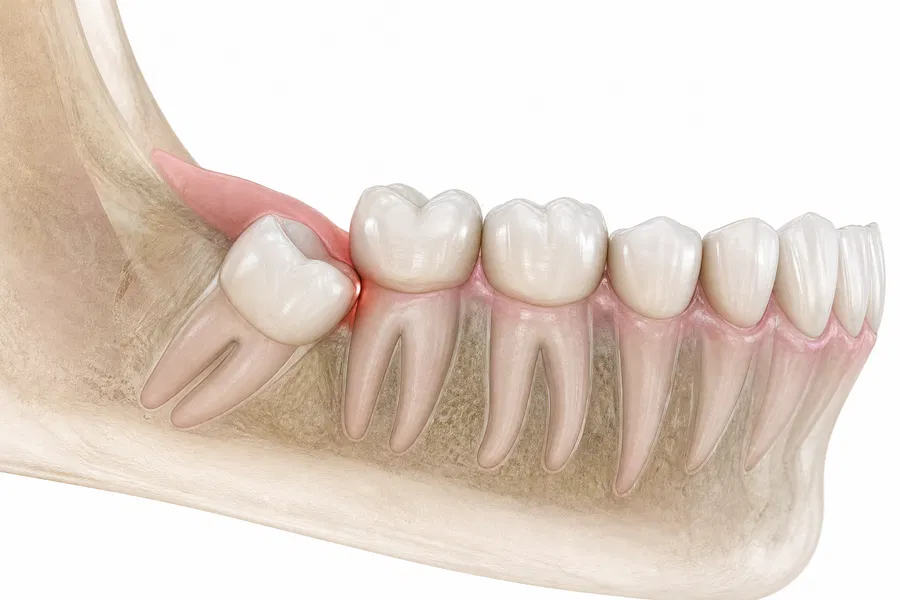
Sometimes impacted wisdom teeth are best left alone. A wisdom tooth can be asymptomatic, uninfected, completely enclosed within the jaw bone and cause no future problems. In other circumstances, the position of the tooth can make cleaning difficult or compromise the second molar.
Ultimately, the decision on whether to extract or observe is made on a case-by-case basis depending on the position and condition of the tooth, the patient’s age, ability to clean the back of their mouth, overall health and what was seen on the X-ray.
Wisdom Teeth Can Be A Problem Even When They Are Not Painful
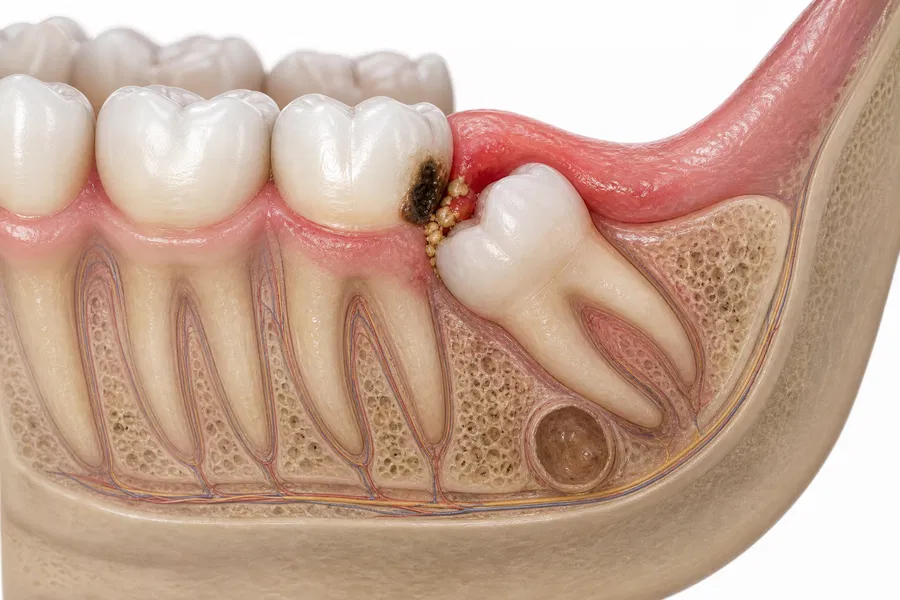
Pain is a symptom, but it is not a reliable early warning. Some wisdom tooth problems can be discovered at an oral examination or on X-ray while the patient is mostly free of symptoms.
Conditions such as:
Food trapping
A partially erupted wisdom tooth can cause food to get caught in the space between the tooth and the gum. This can be uncomfortable and difficult to remove with just a toothbrush. Inflammation, bad breath or even decay can occur as a result of food trapping.
Decay Behind Second Molar
It is common for wisdom tooth decay to occur on the surface of the second molar. The second molar is challenging to clean due to the proximity of the wisdom tooth erupting alongside it. This is particularly true when the wisdom tooth is in a horizontal or angled position.
This is an unfortunate scenario where a healthy second molar can be compromised by the presence of the wisdom tooth next to it.
Gum Pocketing and Loss of Supporting Bone
Plaque accumulation around either partially or fully impacted wisdom teeth can lead to gum inflammation and loss of bone support around the wisdom tooth and the second molar. This can often be difficult to detect with the naked eye without taking periodontal measurements or an X-ray.
Cysts
Cysts may occasionally develop around wisdom teeth. Although rare, they have the potential to cause several problems, including damaging the neighbouring second molar. They may also extend into the lower jaw and cause additional complications. If a wisdom tooth cyst becomes infected, it can sometimes be treated with antibiotics.
Repeated infections
Pericoronitis can affect the tissue around a partially erupted wisdom tooth. It can often come and go, becoming inflamed and resolving on its own with treatment. However, the condition can frequently recur if the pocket around the wisdom tooth remains. An infection may require antibiotics to clear, but it will not remove the source of the problem.
Recovery Timeline
| Time After Extraction | What May Be Normal |
| First few hours | Numbness, light bleeding and tenderness |
| First 24 hours | Blood-stained saliva, soreness and a soft diet |
| Days 2–3 | Swelling or bruising may be at its highest |
| Days 4–7 | Swelling and discomfort should begin easing |
| Around 1–2 weeks | Gum healing continues,s and normal eating becomes easier |
| Following weeks | The deeper socket gradually fills and remodels |
Why Should You See Dr Kevin Ho at Delatite Dental?
Kevin Ho earned a Bachelor of Dental Science from the University of Melbourne and a Postgraduate Certificate in Fixed and Removable Prosthodontics from King’s College London. His clinical experience includes treating a wide range of patients, including older adults, people with extramedical needs, and patients who need careful personalised planning.
Read More About Dr Kevin Ho Here: https://mansfielddentist.com.au/about-us/
If you have pain or swelling at the back of your mouth, need help with wisdom tooth extraction or need any dental consultation, book an assessment with Dr Kevin Ho at Delatite Dental in Mansfield, VIC.
Frequently Asked Questions (FAQs)
Q.1. Can I eat after the procedure?
Wait until the numbness has worn off so you do not bite your tongue or cheek. Begin with soft, cool or lukewarm foods and avoid chewing directly over the socket.
Q.2. Can I exercise after having my wisdom tooth removed?
You should refrain from exercising for the initial stages of recovery because it might cause the bleeding or throbbing to resume. Dr Kevin will guide you through your normal routine depending on the procedure done.
Q.3. Does it become difficult to extract wisdom teeth with age?
Age is not the only determining factor. The root development, bone density, tooth placement, your state of health, and the presence of any disease matter.
Q.4. Do I have to take antibiotics after wisdom tooth extraction?
No. It’s not necessary that you will need antibiotics after an extraction procedure. They are prescribed only if there is a particular clinical necessity.