
It’s common for adults in their 30s, 40s, or beyond to realise their teeth have gradually shifted over time. Crooked or gapped teeth can affect the way they communicate and even how confident they feel in everyday situations. And many adults around the world tend to delay orthodontic treatment because they don’t want visible braces at work, in photos or during social events. And many adults are uncertain whether clear aligners can actually handle the specific issues they experience. One common pattern that we can see is lower front teeth that have become crowded or overlapped as they gradually move with age or wear. Another one is spacing between front teeth that have gradually drifted into a more crooked position over the years.
Research indicates that Invisalign is an effective option for adults with mild to moderate crowding or spacing when there’s no need for extraction. For more complex situations like severe rotation, large extrusions, or skeletal discrepancies, fixed braces are more appropriate options. The point of this blog post is to answer whether Invisalign can reliably address these problems and what use cases it is best suited for.
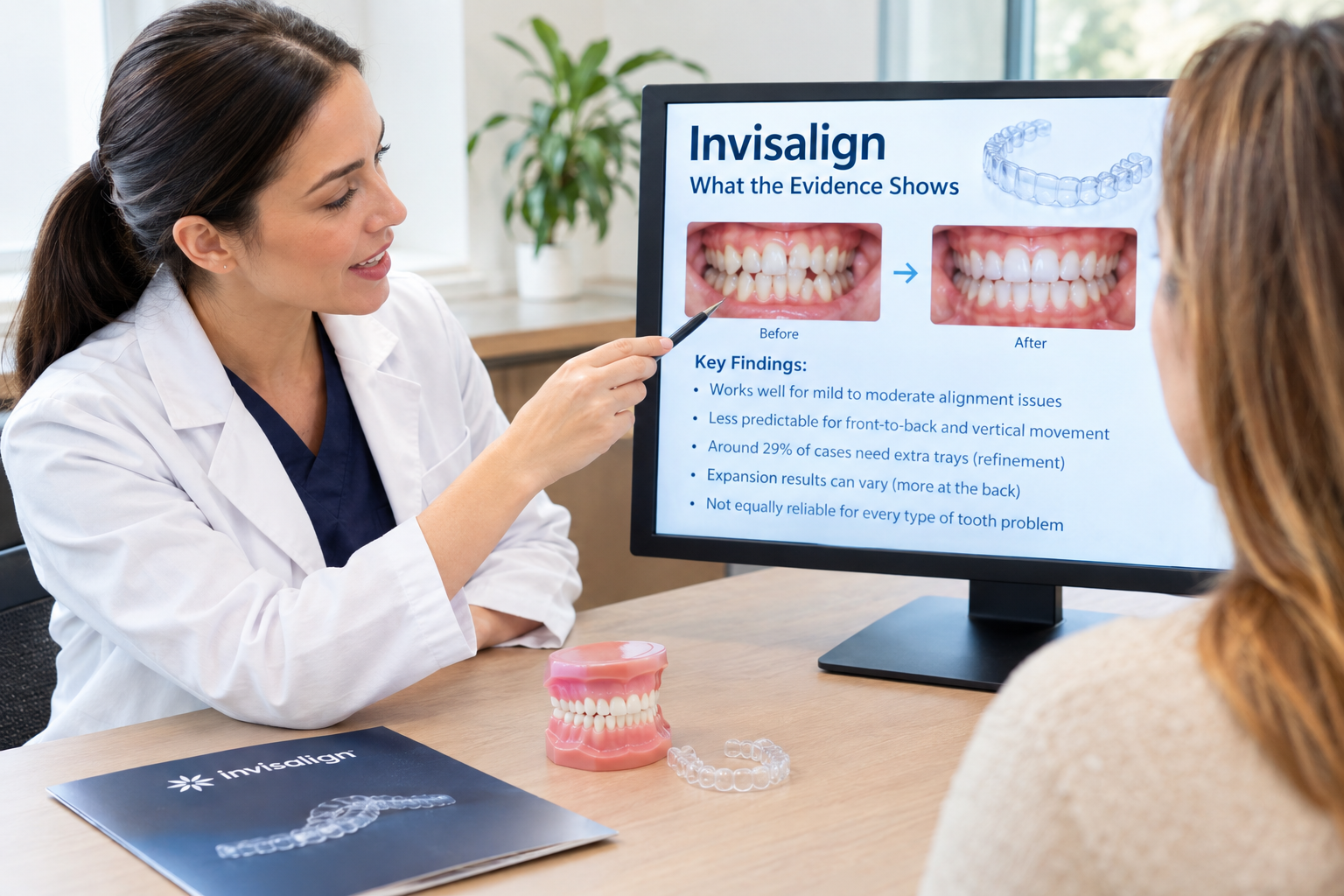
What The Evidence Shows About Invisalign
Let’s get into what published research shows about how well clear aligners work for teeth. Clear aligners have been in clinical use for more than twenty years. So there is now a large amount of research on how effectively they work for teeth. A few studies report that Invisalign can be a workable alternative to traditional braces for adults with mild to moderate bite or alignment problems. Aligners can straighten the teeth effectively in numerous instances, but they are less reliable for some types of movement. Especially front -to-back positioning and up-and-down (vertical) movement are a bit tricky for aligners as compared to fixed braces.
For many everyday alignment issues, overall results can be similar to braces. However, certain individual tooth movements are less predictable with aligners and usually need extra treatments later. Research shows that a significant portion of cases require an additional round of trays because the first set does not fully complete the expected outcomes. One study found around 29% of cases required refinement. Arch expansion with Invisalign is not fully predictable, and the amount of expansion can vary more from the front of the mouth toward the back. Invisalign is a solid option for many adults’ alignment issues, but it is not equally accurate or reliable for every kind of tooth problem.
Treating Crowded Teeth With Invisalign
Crowding is caused by insufficient space for teeth to be in proper alignment, resulting in rotated or overlapping teeth.
Research provides helpful benchmarks for treatment time by severity:
Mild crowding: around 13 months on average.
Moderate crowding: around 16 months.
Severe crowding: around 18 months or more, often with more complex mechanics.
Clear aligners can make changes to intercanine, interpremolar and intermolar width in the presence of crowding, but accuracy of movement is reported in the range of 55–72%, depending on compliance and case complexity.
Clinically, Invisalign is generally suitable for mild to moderate crowding without extractions, while for severe crowding (especially when extractions or significant skeletal correction are needed), fixed braces may be more efficient and predictable.
Many adults in regional areas present with long‑standing crowds that have never been treated. Invisalign can be attractive because it is less visible and easier to manage with work and travel, but case selection is critical.
Closing Gaps With Invisalign
Spacing refers to gaps between teeth, most often between the upper front teeth. Spacing is widely considered one of the conditions most reliably treated by Invisalign. Mild to moderate spacing of about 1-6 mm is a well‑established indication for Invisalign. Case reports show successful closure of anterior gaps with clear aligners when patients wear aligners as directed and use retainers afterwards.
Important caveats:
- Gaps can reopen without proper retention after treatment.
- Some tooth positions are harder to achieve than first planned, potentially extending treatment.
For adults with moderate spacing and otherwise reasonable bite relationships, Invisalign is often an excellent option. Long‑term retainer use is non‑negotiable if the goal is to keep gaps closed.
Crooked Teeth And Bite Problems
“Crooked teeth” can refer to multiple problems:
- Rotated teeth.
- Teeth tipped in or out.
- Teeth that are vertically too high or too low.
- Underlying skeletal discrepancies (jaw size or position mismatch).
Clear aligners are less reliable for severe rotations, large extrusions and significant skeletal discrepancies. They can be deficient in anterior/posterior and vertical corrections compared with fixed appliances. In extraction cases, treatment duration is often shorter with fixed braces than with aligners, although both can be effective.
Patients with major bite problems, significant jaw discrepancies or severely rotated teeth may be better served by fixed braces, sometimes in combination with other treatments such as orthognathic surgery or temporary anchorage devices. Invisalign can still play a role in some complex cases, but expectations must be realistic, and refinements are more likely.
Treatment Time And Predictability
Adults with work, family and travel in Mansfield, Mount Buller and surrounding towns often want a clear estimate of treatment time and number of visits.
Average treatment times from systematic review data:
Mild crowding: around 13 months.
Moderate crowding: around 16 months.
Severe crowding: around 18 months or more.
Some pooled analyses suggest shorter overall treatment time with Invisalign compared to fixed appliances in certain case types, but this varies widely by case complexity and compliance.
Refinements are common. Around 29% of cases in one study required additional refinement trays because the final result did not fully match the initial digital plan. Patients should be told from the start that refinements are normal, not a sign of failure.
Treatment length depends on:
- Severity of crowding or spacing.
- Need for attachments, interproximal reduction (IPR) or elastics.
Compliance And Wear Time
Compliance and wear time: the hidden factor that determines success
Invisalign is not “fit and forget”. Recommended wear time is 20–22 hours per day.
Real‑world compliance data:
- Only about 12–15% of patients achieve 22+ hours daily.
- Around 35–40% maintain 20–22 hours (good compliance).
- A significant portion average less than 20 hours, which can extend treatment and cause tracking issues.
Consequences of poor compliance:
- Aligners may not “track” properly, leading to gaps between the aligner and the tooth, poor fit and the need for additional refinements.
- Treatment time can be extended by 2–6 months or more depending on wear time.
Practical tips:
- Use reminders such as phone alarms or the Invisalign app.
- Remove aligners only for eating, drinking anything apart from water, and cleaning.
- Carry a case to avoid loss or damage when out in town or travelling to the snow or high country.
Quality Of Life, Comfort, And Lifestyle
Adults treated with clear aligners report less impact on daily life during treatment compared with fixed braces.
Clear aligner patients report:
- Lower pain levels in the first days and weeks.
- Less anxiety about appearance and social situations.
- Better oral health‑related quality of life during treatment.
Satisfaction with eating and chewing is higher with Invisalign than with fixed braces because aligners are removed for meals. For adults in Mansfield and the High Country who work in customer‑facing roles, hospitality, tourism or small businesses, clear aligners can be attractive because they are:
- Less visible in meetings and social events.
- Easier to manage during busy periods, such as ski season or harvest time.
But they demand discipline. If lifestyle means frequent removal and low wear time, results will suffer.
Patients living in Mansfield, Mount Buller, Benalla, Euroa, Jamieson, Whitfield, Merrijig, Eildon, Tolmie, Alexandra and Bonnie Doon can come to Delatite Dental to check if they’re a good candidate for Invisalign treatments.
Choose Delatite Dental For Invisalign In Mansfield
For patients in Mansfield and the surrounding High Country, the most useful step is an honest review of whether clear aligners fit their particular dental problems. If you are considering Invisalign in Mansfield or surrounding High Country towns, a detailed consultation can clarify whether your crowding, crooked teeth, or gaps are well suited for the same.
Are you still confused about whether Invisalign is the right choice for you? No worries! Bring your questions and concerns to Delatite Dental in Mansfield. We’ll explain everything in detail and plan out the best dental solution for your problems.
Frequently Asked Questions (FAQs)
Is Invisalign better for crowded or gapped teeth than braces?
For minor to moderate crowding or spacing, Invisalign can be as effective as braces and more comfortable. However, for severe crowding, rotations, or complex bites, fixed braces are usually more predictable.
How long does Invisalign take to fix crowded or spaced teeth?
It depends on the severity of the problem. On average, treatment time is about 13 months for minor crowding, 16 months for moderate crowding, 18 months or longer for extreme crowding or rotations, and less for simple spacing.
Can Invisalign close large gaps between front teeth?
Invisalign is fantastic for mild to moderate spacing (up to 1-6 mm). However, extensive spacing may require bonding or other procedures to prevent the gaps from reappearing.
Will Invisalign work for extremely crooked or rotated teeth?
Invisalign can handle moderate rotations, but extremely crooked or rotated teeth are often better treated by fixed braces or combined with Invisalign refinements.
Do I need to wear retainers after Invisalign to prevent my teeth from shifting?
Yes, as with any orthodontic treatment, you will need to wear retainers to prevent your teeth from shifting back to their previous positions, especially when it comes to crowded or spaced teeth.
How long does Invisalign have to be worn for the treatment to be effective?
Invisalign aligners have to be worn 20–22 hours per day. In practice, this means that if you sleep fewer than 8 hours per night, you probably won’t be compliant.
Will I need refinements to my Invisalign treatment?
Unfortunately, there’s an upward of 29% chance that you’ll need refinement treatment if your teeth don’t fit the final digital set-up.
Can Invisalign fix my bite, or is Invisalign only for straightening?
Invisalign can correct many types of malocclusion, including overbite, underbite, and crossbite. However, more complex or extreme bites may need to be fixed using fixed braces, elastics, or other orthodontic appliances.
I’m in my 40s, 50s or older; am I too old for Invisalign?
Not at all! Many patients begin Invisalign treatment at age 45 or older. Invisalign can be effective for older patients as long as their gums are healthy and their teeth are still mobile.
How do I know if I’m a candidate for Invisalign in Mansfield?
Just do a dental examination with X-rays and a digital scan to assess the situation. If you do not need a major extraction, you would be a good fit for getting Invisalign.