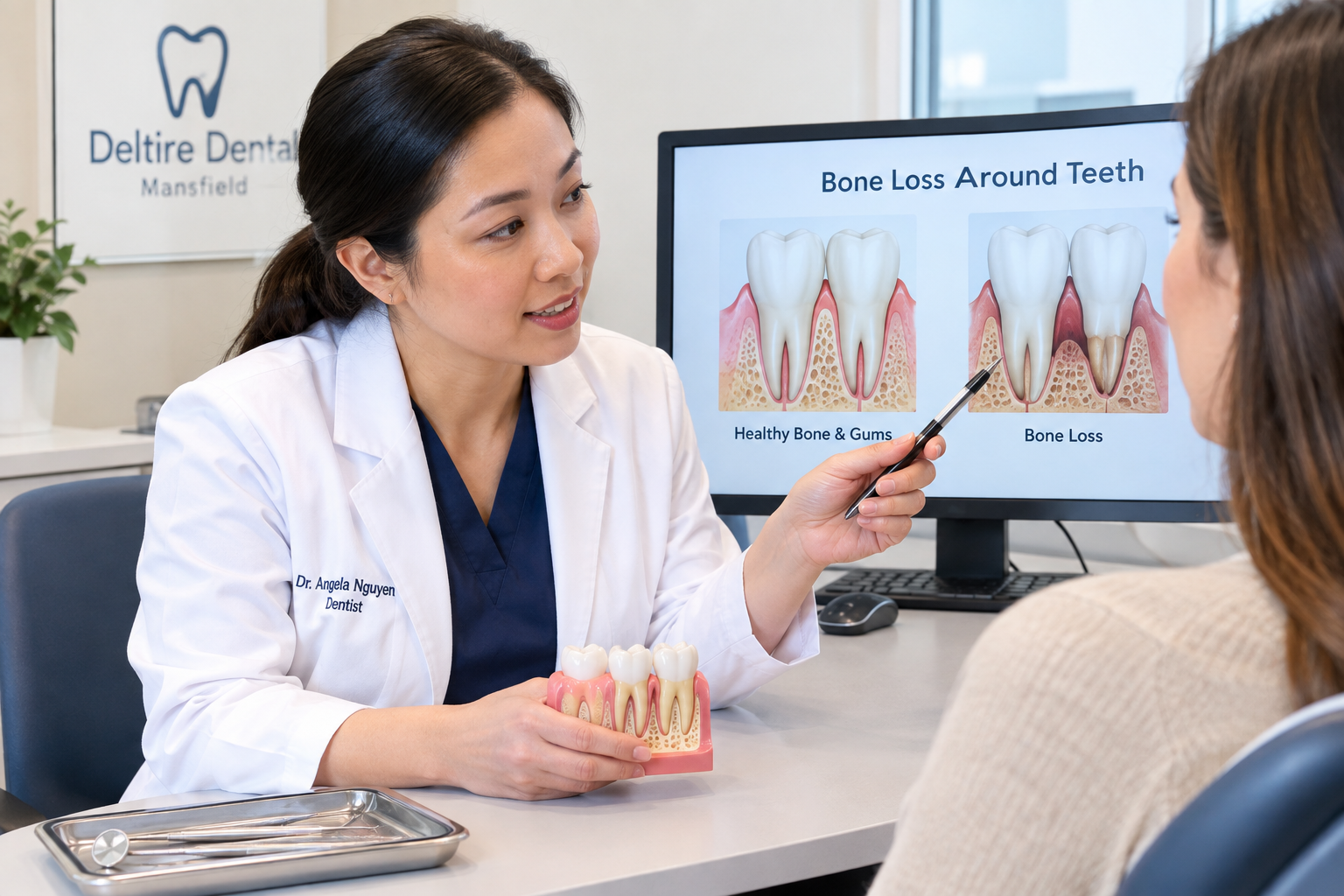

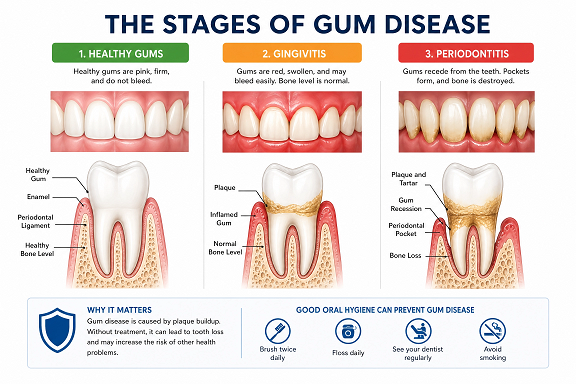
Gingivitis and periodontitis are both types of gum disease, but they are different stages and have different effects. Gingivitis is a milder, early form of gum disease in which inflammation is only in the gums. It can normally be reversed with good cleaning and professional care. Periodontitis is the more advanced stage that happens when the inflammation moves to a deeper level. It damages the tissues and bone supporting the teeth.
Did You Know?
According to the World Health Organisation, severe periodontal disease affects around 19% of adults worldwide, making it one of the most common oral diseases globally.
The damage from periodontitis is permanent and cannot be fully recovered, unlike gingivitis. So that’s the basic difference between them. Because the right treatment and expected outcome are different for each, dentists must accurately identify whether it is gingivitis or periodontitis before suggesting any treatment to their patients.
This guide will cover how dentists diagnose both conditions and what they look for during the examination.
First Things First: What’s the Difference?
Both conditions are types of gum disease, but they differ significantly in severity. Take a look at the difference:
| Gingivitis | Periodontitis |
| Inflammation affects gums only | Infection has damaged supporting tissues around teeth |
| Usually caused by plaque buildup | Develops after untreated gingivitis |
| No permanent bone loss | Bone loss has occurred |
| Usually reversible | Damage cannot be completely reversed |
| Improves with professional cleaning + better home care | Requires periodontal treatment + ongoing maintenance |
Gingivitis usually is the mild stage, and it is the mild stage that comes before a more serious stage. When plaque and bacteria are left around the gums for a long time, some individuals may progress to periodontitis.
Looking at Your Gums Isn’t Enough
People generally believe that just by peering into your mouth, dentists know what’s going on.
Sadly, that’s not what happens!
Two individuals can actually have gums that look fairly comparable. Simple gingivitis may be present in one. Simple gingivitis can occur in one of them. Or the other may already be suffering from periodontal disease. It’s because the largest change isn’t always something you can see. It’s the area below the gums.
That is one of the reasons dentists undertake multiple examinations prior to diagnosis. Imagine a house with a cracked wall, and you’ll understand. Paint is just a small piece of the picture. To implement, you have to look under the surface from time to time.
Step 1: Checking the Appearance of Your Gums
All exams start with an eye test.
When examining, your dentist is searching for:
- redness
- swelling
- shiny gum surfaces
- plaque
- tartar
- gum recession
- areas that collect food easily
Gums should be pale pink (the colour varies among individuals) and firm and are well suited to encircle each tooth. Swollen gums bleed more easily and are inflamed.
However…
You do not necessarily have to have swollen gums for there to be a problem with your gums. Similarly, don’t dismiss it if the gums appear to be not that noticeably swollen.
Step 2: Measuring Your Gum Pockets
This is likely the top question asked by patients! A very thin device that is known as a periodontal probe is used by your dentist. They then move it very slowly between the tooth and gum as they count out different numbers.
“Two.”
“Three.”
“Four.”
Have you ever had any thoughts of, “Could my dentist be a conspiracy theorist that reads the lottery numbers????”
Nope.
They’re measuring the depth of the space between your gum and tooth. A healthy gum space typically is 1–3mm in depth. If something goes wrong and inflammation sets in, the spaces can grow deeper.
The deeper pockets provide space for plaque and bacteria to accumulate that a toothbrush can’t clean. It is one of the largest signs that someone has periodontitis. But (This is important):
You may not necessarily have periodontitis just because you have a deep pocket. Excessive gum swelling in places may result in a pseudo-pocket—which appears deeper than it is, but is really not because there is no damage to the bone that supports the tooth.
Fun Fact
During a full periodontal examination, dentists usually record six measurements around every single tooth.
If you’ve got 28 teeth, that’s 168 measurements.
Step 3: Checking for Bleeding
Of course, no one wants to see blood when brushing and flossing their teeth. Bleeding is a definite indication of inflamed gums. When the periodontal probe is inserted into the area during the examination, it may bleed a little in the inflamed area. This is referred to as bleeding around the probing.
Your dentist is better able to find out where your inflammation is active by the amount and location of your bleeding.
However…
Periodontitis is not a condition that will inevitably happen when there is bleeding. Gingivitis is characterised by bleeding. Rather than bleeding, though, it’s a component of a much bigger picture.
Step 4: Looking for Gum Recession
Do your teeth appear to have grown longer? Don’t falsely attribute matters to the imagination. Wrong! In other instances, the gums erode the teeth gradually. This is known as gum recession.
It may be due to:
- gum disease
- aggressive brushing
- teeth grinding
- thin gum tissue
- orthodontic movement
Periodontitis cannot be diagnosed solely based on someone’s recession. However, this is a whole new ball game with bone loss, deeper pockets, and attachment loss. Most often, it is when cold drinks feel colder than usual. Not everyone’s tooth root was expected to feature in the dialogue.
Step 5: Measuring Attachment Loss
Measuring attachment loss is one of the most important ways dentists distinguish between the two stages of gum disease. It shows how far the problem has progressed. Most patients are not familiar with the term or concept of attachment loss. Healthy gums form a tight seal and attach firmly to the surface of each tooth. This attachment is an important part of oral health. During gingivitis, the attachment between the gums and teeth generally stays in place. The problem is limited to inflammation. The gums become red, swollen, and irritated in gingivitis. Even though the gums are inflamed, they have not started to pull away from the teeth. In periodontitis, the attachment between the gums and teeth begins to break down and move lower along the tooth root. Ongoing bacterial activity damages the tissues that hold the gums in place. Over time, this leads to the loss of the normal gum attachment. Dentists refer to this process as clinical attachment loss.
This attachment loss is a primary reason why periodontitis cannot be reversed just by better brushing. The damage goes deeper than surface inflammation. After attachment and bone are lost, treatment aims to delay additional damage and prevent worsening, but it can not fully restore what has already been lost.
Step 6: Taking Dental X-Rays
If dentists only looked at what is visible in the mouth, they would overlook many important details. Visual checks alone are not enough for a full diagnosis. X-rays provide valuable information that cannot be seen from outside. They allow dentists to look beneath the gums and assess hidden structures. Dental X-rays let dentists view the bone levels around the roots of the teeth. In a healthy mouth, the supporting bone is positioned near the top (neck) of the tooth, which is a normal healthy level. In periodontitis, the bone that holds the teeth in place slowly deteriorates and moves lower, which is a clear sign of the disease. The bone loss seen on X-rays usually supports the findings from the clinical exam with pocket measurements and other signs.
X-rays are essential because they are the only way to accurately measure how much bone support has been lost below the gumline. Pain and actual bone loss do not always happen at the same time. Bone loss can occur without noticeable discomfort. Bone loss from periodontitis can continue for years with very few obvious symptoms; this is why regular checkups are important.
Important Fact
Research shows that periodontal disease can progress without obvious pain, which is one reason regular dental examinations remain so important.
Step 7: Checking Whether Teeth Have Become Loose
Even healthy teeth have a small amount of natural movement. They are not fixed rigidly in place. Teeth have a small degree of flexibility due to the periodontal ligament that holds them in the bone. When teeth move more than normal, it usually indicates a problem. This is a warning sign that something is wrong with the supporting structures. When bone support around teeth is lost due to periodontitis, the teeth can start to feel loose or wobbly. During the check-up, dentists carefully test how much each tooth moves. Having loose teeth does not mean that the tooth must be pulled out. They signal to the dentists that the bone and tissue supporting the tooth need more detailed evaluation.
Why Dentists Never Depend on Just One Test
Imagine trying to judge an entire football match by watching only the final two minutes. It would give away a very incomplete picture of what went down. Diagnosing gum disease requires looking at the full picture, just like understanding a whole game. Dentists gather data from multiple checks and factors during the dental examination. We assess how much plaque and hardened tartar (calculus) is present on the teeth. We check for:
- Visual examination
- Plaque and tartar levels
- Pocket measurements
- Attachment loss
- Gum recession
- Tooth mobility
- X-rays
- Medical history
- Smoking status
- Conditions like diabetes
Only after considering all these factors together do we make a confident diagnosis of gingivitis or periodontitis.
What Happens After the Diagnosis?
The recommended treatment is based completely on the results of the dental examination. There is no individualised plan for it. So if it’s gingivitis, it can typically be reversed with proper care, as it is not a permanent condition.
Treatment includes:
- Professional cleaning
- Removing plaque and tartar
- Brushing and flossing device
- Improving daily oral hygiene
- Follow-up appointments to check healing
Most patients see a significant reduction in gum bleeding within a few weeks when plaque is consistently removed.
If it’s periodontitis, it generally requires more intensive treatment because the infection has moved deeper below the gums. The exact treatment depends on how advanced the disease is, which includes:
- Periodontal charting
- Scaling and root planing
- Regular periodontal maintenance appointments
- Improved home care
- Referral to a periodontist is more advanced cases
The objective is to stop the disease from progressing and help preserve the teeth for as long as possible
Final Words
Gingivitis and periodontitis may sound similar, but from a dentist’s perspective, they are very different. That difference is proven through proper examination. Dentists rely on a combination of processes like gum measurements, X-rays,s and other clinical findings to determine whether the disease is still limited to the gums or has already affected the bone and supporting tissues.
If you or someone you know is dealing with bleeding gums or gum diseases, don’t hesitate to visit a nearby dentist and get your oral health checkup done.
Frequently Asked Questions (FAQs)
Q.1. Why does my dentist check my gums each time I visit him for a check-up?
The reason behind such an examination is the measurement of the depth of spaces between your teeth and gums. By comparing these measurements, your dentist can identify early signs of the development of some gum diseases or check the effectiveness of previous treatment of a certain condition.
Q.2. Does bleeding of gums indicate the presence of periodontitis?
It is a very common symptom of gingivitis but does not necessarily indicate the presence of periodontitis. The diagnosis of this disease requires additional tests.
Q.3. Is it possible to have periodontitis without pain?
Yes. Periodontitis develops quietly and is often asymptomatic during its early stages. Therefore, periodic dental checkups play a significant role in the prevention of this disease because changes can occur even without any visible signs.
Q.4. Do deep gum pockets necessarily indicate the presence of periodontitis?
It is not necessary,y as swollen gums can form pseudo-pockets.
Q.5. Is it possible to develop periodontitis if I do not treat gingivitis?
Yes, because untreated gingivitis leads to periodontitis. Unlike the first one, the second disease causes irreversible changes to the structures surrounding teeth.